
Reviewed · MUSEUMS
London Transport Museum One Day Ticket
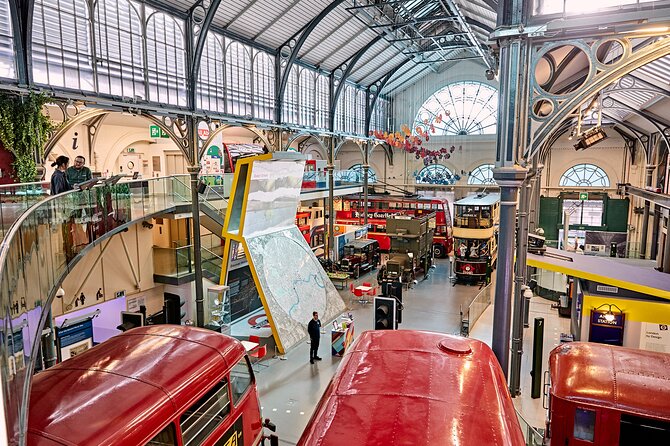
London’s story is tied to its buses, taxis, and Underground trains, and this museum makes that story easy to see. You move from horse-drawn buses to electric trains, then on to the red double-deckers and tube cars that helped London grow. I like the restored vehicles and the way the exhibits explain why each change mattered. I also like the freedom to set your own pace, with no guide rushing you from one display to the next.
The main thing to consider is timing. The museum can get loud and crowded during school holidays, especially around the children’s play areas. If you want time to read the displays, choose a quieter period rather than expecting a calm museum visit at the busiest family hours.
Key things to know before you go
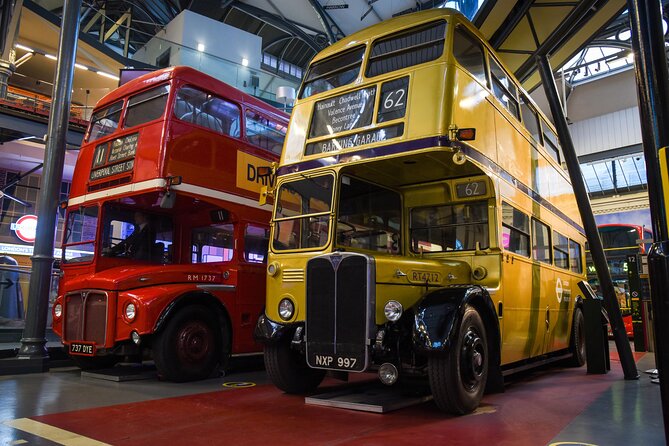
- See transport from 18th-century coaches to modern London icons, including buses, trams, black cabs, and Underground trains.
- Use the All Aboard playzone for hands-on activities aimed especially at children.
- Plan on about two hours, but stay longer if you want to read the displays, use the interactive areas, or browse the shop.
- Visit in Covent Garden, a central location that fits neatly into a day of sightseeing.
- Choose a time slot that suits your plans, with admission handled by mobile ticket.
- Watch the school-holiday calendar, when the museum may be noisy and harder to explore at a relaxed pace.
Why London’s transport story matters
The London Transport Museum is not simply a collection of old vehicles. It shows how the city changed when people could move farther, faster, and more reliably. A bus route, a railway line, or a new Underground station could connect homes with jobs, markets, schools, and the growing center of London.
That makes the museum useful even if you are not a transport enthusiast. You get a clear picture of how London developed over roughly two centuries, told through machines people once used every day. The subject is practical and familiar: red buses, black cabs, trams, and the Tube.
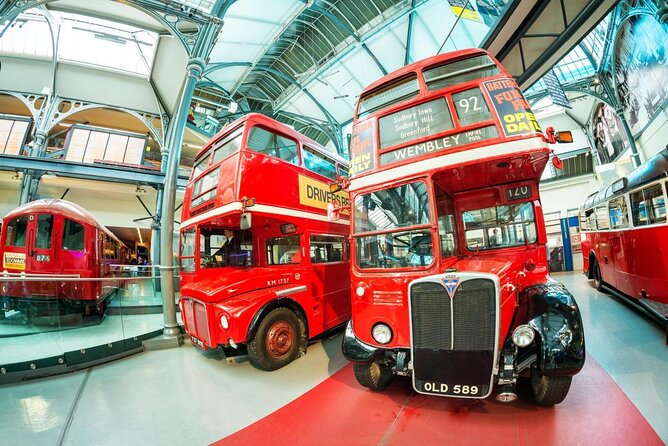
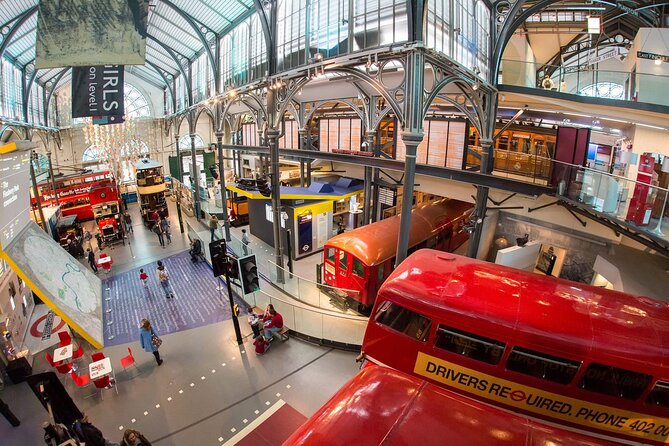
I especially like that the museum keeps the story close to real objects. A restored vehicle gives you a better sense of scale than a photograph alone. You can look at the seating, windows, controls, and painted details, then connect them with the posters and facts around the gallery.
The setting helps, too. The museum occupies a refurbished old flower market in the heart of Covent Garden. It feels more characterful than a purpose-built exhibition hall, and its central location makes it a simple addition to a day in this part of London.
More Day Trips in London
- Guided Luxury Paris Day Trip with Optional Lunch at the Eiffel Tower
★ 4.5 · 2,702 reviews - London In One Day Tour with River Cruise & London Eye Option
★ 4.5 · 1,678 reviews - London: South Downs White Cliffs Day Trip with Train Tickets
★ 4.9 · 1,441 reviews
The first galleries: from horse-drawn buses to a growing city
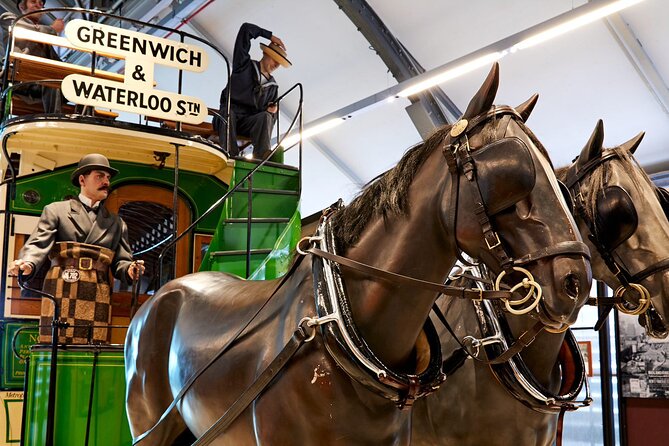
Your visit begins with London’s earlier public transport, including horse-drawn buses from the 18th century. These vehicles show just how different city travel once was. There were no electric motors or underground lines, and the basic idea of public transport depended on horses, roads, and a much slower pace.
The displays connect these vehicles to the city around them. London did not grow in isolation from transport. As public services improved, people could travel between more parts of the city, and London became easier to cross for work and daily life.
You will see facts and displays that put the vehicles into context rather than leaving them as silent antiques. This is one reason I would allow more than a quick walk-through if you enjoy city history. The museum gives you a useful explanation of why a particular vehicle mattered, not just what it looked like.
The layout can take a little getting used to. There are several floors, and the route may not feel perfectly obvious at first. Instead of trying to race through every room in order, take a moment to get your bearings and follow the areas that interest you most.
The Underground trains and the famous Tube map
London’s Underground is one of the museum’s main subjects, and you get to see the world’s first underground steam and electric trains. These are the vehicles that made London’s transport system famous far beyond the city.
The shift from steam to electric power is an important part of the story. It reflects the push to make underground travel more practical and better suited to a large city. The museum helps you see the Tube as a piece of engineering and as a force that changed ordinary routines.
The Tube map also receives attention. It is more than a helpful diagram for visitors. Its simple lines and clear stations became one of London’s most recognizable designs. At the museum, the map fits into the wider story of how a complex transport network was made understandable to the public.
You will find interactive displays alongside the trains and signs. These add movement to what could otherwise be a display-heavy visit. I like this mix because you can spend time with the facts, then shift to something more hands-on when your attention starts to wander.
Red buses, trams, black cabs, and vintage vehicles

The restored buses are likely to be a highlight, especially if this is your first London visit. The classic red double-deckers are instantly familiar, but seeing them up close gives you details that a street view cannot provide. You can appreciate their size, design, and role in daily city life.
The trams and vintage vehicles add variety. They show that London transport was never just about the Tube. Different parts of the system served different needs, and the museum brings those pieces together in one place.
Black cabs receive their own place in the story. They are part of London’s public image, but the museum treats them as working transport rather than decoration. Together, the buses, taxis, trams, and trains explain why London feels so closely linked to its transport network.
The vehicles also give children something concrete to look at. Young visitors who do not want to read every panel can still climb into or explore parts of the display, depending on the area open to them. That makes the museum easier to enjoy as a family, with adults learning from the written material while children focus on the vehicles and activities.
More Museum Tours in London
- Tower of London and Crown Jewels Exhibition Ticket
★ 4.5 · 6,677 reviews - London: Chelsea Football Club Stadium and Museum Tour
★ 4.8 · 4,576 reviews - Chelsea FC Stadium Tours and Museum
★ 5.0 · 1,908 reviews - London Transport Museum Entrance Ticket
★ 4.5 · 1,323 reviews
All Aboard: the strongest part for younger children
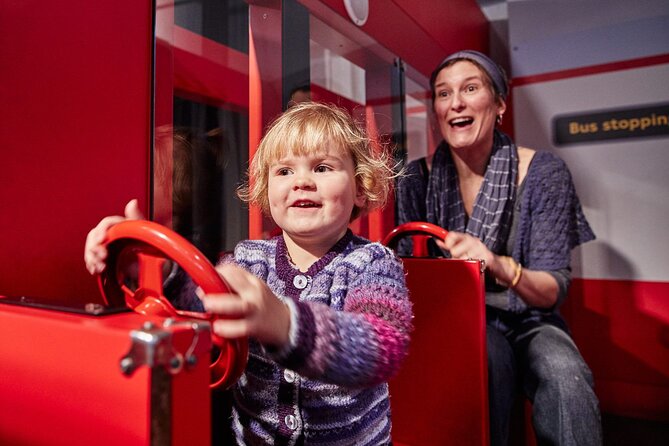
Families with children will want to set aside time for the All Aboard playzone. It lets children take on transport roles such as conductor, mechanic, or driver, with interactive vehicles and activities built around those jobs.
This is more useful than a basic corner with a few toys. It connects play with the museum’s subject. A child can pretend to operate a vehicle, then look at the real buses, trams, or trains nearby and better understand how people worked with them.
Children can also take part in hands-on activities such as getting a card stamped and pretending to drive vehicles. These small tasks can keep younger visitors involved while adults read the surrounding displays.
The play areas are a major reason the museum works well for families, but they also explain the main drawback. During school breaks, the museum may be noisy, with children moving quickly between activities. If your priority is a quiet look at the exhibits, avoid those periods if your schedule allows.
For a visit with a five-year-old or children around the six-to-ten age range, I would treat the playzone as a central part of the plan rather than a side attraction. Older children may spend more time with the transport facts and London stories, while younger ones will get more from the role-play areas and vehicles.
Posters and displays that explain London beyond the machines
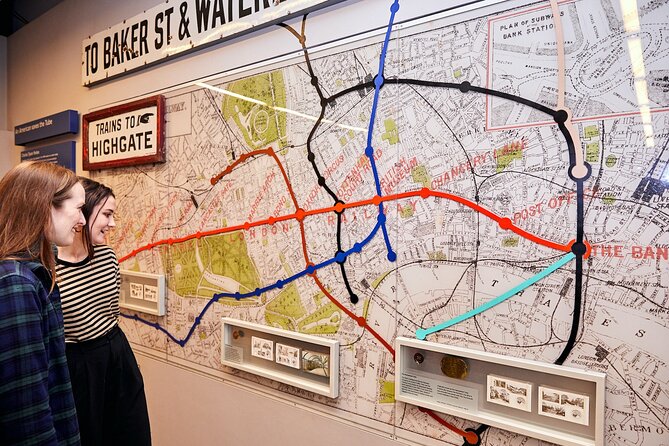
The museum uses colorful posters and interactive displays to show how transport was presented to the public. These posters are not just decoration. They reveal how London encouraged people to use buses and trains, promoted destinations, and shaped a shared image of the city.
The displays also touch on London during wartime. That gives the visit an extra layer, since transport continued to matter during periods of danger and disruption. The museum does not only show what people rode. It also helps explain how the system fit into London life during difficult years.
I find this part valuable for visitors who want more than a vehicle collection. The transport objects are the hook, but the posters and written material tell you about work, leisure, travel habits, and the city’s changing identity.
Much of the written information is in English. If you are not comfortable reading English, the vehicles and visual displays remain accessible, but you may miss some of the detail in the text panels.
How long to spend inside
The stated visit time is about two hours, and that is a sensible minimum for a steady look at the main displays. You can see the vehicles, explore some interactive areas, and stop at the children’s zone within that period.
Still, the ticket allows you to explore at your own pace and spend as much time as you like during your visit. That flexibility matters because families rarely move at the same speed. One child may want to play, another may want to climb into a vehicle, and an adult may want to read every panel about the Tube map.
I would allow extra time if you plan to visit the shop or stop at the museum’s Canteen cafe-bar. If you are building a full Covent Garden day, two hours gives you a clear museum visit without taking over the entire afternoon.
The museum’s central location also helps with planning. You can pair it with other time in Covent Garden, rather than making a special journey to an out-of-the-way site. It is near public transportation, so you can fit it into a wider London sightseeing plan without much fuss.
Is the $33.76 ticket good value?

At $33.76 per person, this is not a bargain attraction for a very short stop. The value depends on how fully you use the museum and who is with you.
For an adult who spends only an hour moving past the main vehicles, the price may feel high. You are paying for a museum visit rather than a guided tour, a ride through London, or a special event. Food and drink are not included, so a stop at the Canteen adds to the cost.
For a family, the calculation looks better if children use the All Aboard playzone and interactive displays. The museum can occupy a substantial part of an afternoon, and it gives adults something worthwhile to see as well. That balance is important: this is not only a children’s attraction with a few old buses added.
The ticket is also easier to justify if you have a strong interest in London’s Tube, buses, or urban development. You get a focused look at subjects that are otherwise scattered across the city. If you are already planning time in Covent Garden, the location adds practical value.
I would book it for the museum’s mix of restored vehicles, city history, and hands-on activities. I would not book it expecting a low-cost, silent gallery or a guided experience led by a named tour guide. No guide is assigned, and the visit is self-paced.
Timing, access, and small practical points
You can choose from multiple time slots, which helps you fit the museum around other plans. Confirmation is provided when you book, and the ticket is mobile. Given that one visitor had trouble accessing a ticket and had to pay again at the museum, I would make sure your mobile ticket is ready before you arrive.
The museum is accessible by buggy, and a lift connects the floors. Service animals are allowed, and the attraction is near public transportation. Most people can take part without special arrangements.
The museum has a cafe-bar called Canteen and a transport-themed shop. Food and drink are not part of admission, but the cafe gives you an easy place to pause. The shop is worth a look if you want a London souvenir that is more closely tied to the museum than a generic city gift.
Free cancellation is available if you cancel at least 24 hours before the experience start time. Changes or cancellations made later are not accepted for a refund, and the cut-off follows local London time.
Who will enjoy this museum most?
I would recommend the London Transport Museum most strongly to families with children, London first-timers, and anyone who likes seeing how a city works. The mix of real vehicles and interactive activities gives different age groups something to do.
It is also a good choice if rain threatens your London plans. The museum offers a contained indoor visit in a central part of the city, and you can control the length of your stay.
You may enjoy it less if you want an intimate, quiet museum with a simple route and little activity around you. The layout can be confusing, and school-holiday crowds can make the experience loud. The museum is at its best when you accept that it is both a transport museum and a family attraction.
Should you book the London Transport Museum?
Book it if you want a practical look at London through its buses, Tube trains, trams, black cabs, posters, and maps. The museum explains how public transport helped shape the city, while the All Aboard playzone gives children a real reason to stay engaged.
I would choose a quieter time outside school breaks and allow at least two hours. Families should budget extra time for play, the Canteen, and the shop. Adults traveling without children should focus on the restored vehicles, Underground story, posters, and city-development displays.
At $33.76, the ticket makes the most sense when you plan to stay long enough to use the museum fully. If that sounds like your kind of London afternoon, this is a worthwhile stop in Covent Garden.
FAQ
Where is the London Transport Museum?
The museum is at The Piazza, London, WC2E 7BB, in Covent Garden.
How long does a visit take?
The approximate visit duration is two hours, though you can spend as much time there as you like during your visit.
What does the ticket include?
The ticket includes entrance to the London Transport Museum. Food and drink are not included.
Is the ticket available on a mobile phone?
Yes. The experience offers a mobile ticket.
Is the museum suitable for children?
Yes. The museum includes the All Aboard playzone, interactive vehicles, activities, and areas where children can pretend to be conductors, mechanics, or drivers.
Can visitors with mobility needs access the museum?
The museum has buggy access and a lift to other floors. Service animals are allowed, and most travelers can participate.
Just added in London
- Royal London Guided Sightseeing Tour and Thames River Cruise★ 4.0 · 31 reviews
- Roman Ruins to Blitz Bombings: A Walking Tour of London’s Fiery History★ 5.0 · 190 reviews
- Roman London Private Walking Tour★ 5.0 · 44 reviews
- Westminster Abbey, Big Ben, Buckingham Guided Tour of London★ 5.0 · 451 reviews
- River Thames Evening Cruise with Sparkling wine and Canapés★ 4.0 · 569 reviews
- Rock and Roll Walking Tour of Soho London★ 4.5 · 64 reviews
- Rich people behaving badly★ 5.0 · 47 reviews
- Speedboat Sightseeing: Embankment OR Westminster Pier -45 Minutes★ 5.0 · 288 reviews
Museums, compared.

Liverpool Football Club Museum and Stadium Tour
Read our review →
Tower of London and Crown Jewels Exhibition Ticket
Read our review →
Chelsea Football Club Stadium and Museum Tour
Read our review →


Browse the lists this tour appears in