
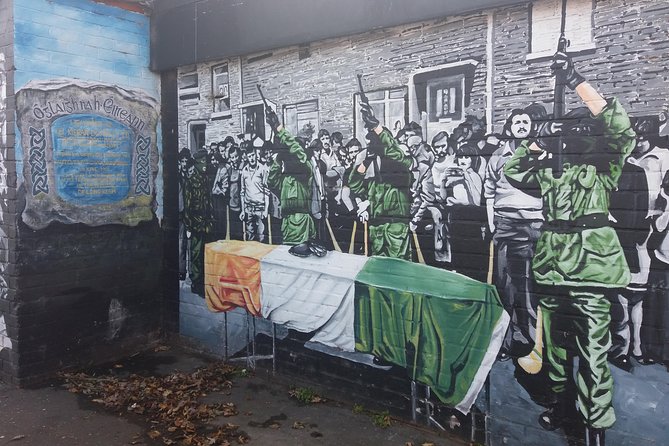
Reviewed · MUSEUMS
IRA Troubles Conflict Private Tour Museum Graves Murals and Political Analysis
Belfast’s past feels most immediate on the streets where it happened. This private tour takes you through Falls Road, Shankill Road, Clonard, Milltown Cemetery, and the peace walls, then adds access to a small Irish Republican museum that is not normally open to the public. You hear the story mainly from a Republican perspective, including the guide’s own memories of Belfast.
I like the private format, since you can stop, ask direct questions, and adjust the conversation to your interests. I also like the unusual combination of murals, memorial gardens, graves, and a museum with former prisoners connected to the conflict. The main consideration is clear: this is not a neutral, two-sided overview. If you want equal treatment of Republican, Loyalist, and British arguments, choose a balanced political tour instead.
Key points at a glance
- Republican Belfast in detail: Follow the story through Falls Road, Clonard, Ballymurphy, and Divis.
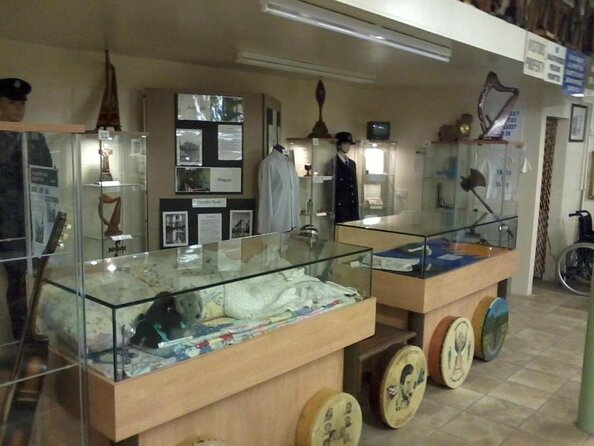
- Private museum access: Visit the Eileen Hickey Irish Republican History Museum when it is open, usually Tuesday to Saturday from 10 a.m. to 2 p.m.
- Peace walls up close: See the barriers between Nationalist and Unionist areas, and leave a written message of peace.
- Milltown Cemetery: Visit the Republican plots and the grave of Bobby Sands.
- Personal guiding: Barry, Paula, Joe, Ciarán, Brendan, and other local guides are named in the tour material, with guide assignment depending on availability.
- Three hours, many stops: The route covers a lot quickly, so expect short visits and plenty of driving between sites.
What this Belfast political tour is really about
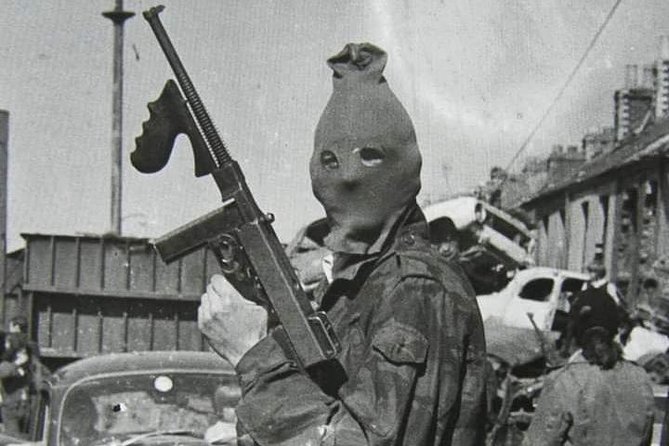
This is a focused political history tour, not a general sightseeing loop. Its subject is Irish Republicanism, the origins of the Provisional IRA, the conflict from 1969 onward, the hunger strikes, and the continuing division of Belfast.
That focus gives the tour its strength. You are not simply pointed toward a mural and told who painted it. Your guide explains the events, people, neighborhoods, and arguments tied to the site. Guides such as Barry, Paula, and Joe are described as bringing personal experience of growing up in Belfast during The Troubles, which can make the material feel less like a textbook and more like local memory.
It also creates the tour’s main weakness. The story is told from an Irish Republican point of view. Loyalist groups, the British government, and the Unionist community appear as participants in that story, but their case is not given equal space. That is not a flaw if you book this for the stated purpose. It matters a great deal if you expect a balanced account.
The language can also be emotionally charged. Memorial gardens honor dead Republican volunteers, while Loyalist murals feature paramilitary symbols and armed figures. You should come ready for difficult subjects, including shootings, prison, civilian deaths, hunger strikes, and sectarian displacement.
More Museum Tours in Belfast:
- Belfast Titanic Museum and Sighseeing Tour
★ 4.5 · 59 reviews - Liverpool: Liverpool Football Club Museum and Stadium Tour
★ 4.8 · 10,764 reviews - Tower of London and Crown Jewels Exhibition Ticket
★ 4.5 · 6,677 reviews
Falls Road murals and the first view of divided Belfast
The tour begins around the International Mural Wall on Divis Street and the Falls Road area. This is where the guide lays out the long background to the conflict, then moves toward the events that brought Belfast into open violence in 1969.
The murals are not decoration in the usual tourist sense. They are political statements, memorials, historical lessons, and signs of community identity. Some were painted by former prisoners, and many refer to Republican struggle, Irish unity, hunger strikers, or international causes.
Your guide may also explain the Battle of the Falls in 1970 and earlier violence, including the Falls Road Massacre of 1920. This broader timeline is useful because The Troubles did not appear from nowhere. The tour tries to connect earlier British rule and Irish resistance with the modern conflict.
The opening stop is listed as about 10 minutes, so do not expect a long walk through every mural. The value comes from the explanation and from seeing the area in context. Wear comfortable shoes, but remember that much of the route is vehicle based rather than a long walking tour.
Peace walls, gates, and the reality of separation
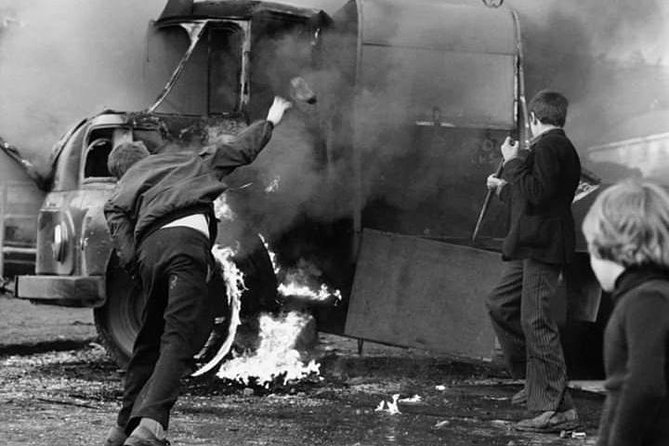
The peace wall between the Falls and Shankill areas is one of Belfast’s most striking sights. It was built to keep Republican and Loyalist communities apart after rioting and attacks drove people from their homes. What began as a temporary measure remained in place because it reduced immediate violence.
The barriers became longer and more numerous over time. Some were built after the IRA ceasefire of 1994, a reminder that physical separation did not end with the formal reduction in violence.
You visit both sides of the wall and can sign your name or write a message of peace. That small act gives the stop a personal edge, but the wall itself remains sobering. It is not an old ruin. The continued presence of gates and barriers shows that Belfast’s division has not simply been packed away as museum history.
A quick visit cannot explain every local dispute, so ask questions if you want to understand how the wall affects daily life. The private setting helps here. Your guide can spend more time on the point that interests you instead of following a fixed group script.
Shankill Road and the Loyalist side
The route crosses into Shankill Road, the best-known Loyalist area on the tour. Here you see murals connected with the Ulster Defence Association, Ulster Freedom Fighters, and Ulster Volunteer Force, along with imagery of masked men and weapons.
This is an important counterpoint to the Republican neighborhoods, even though the tour’s overall interpretation remains Republican. You see how Loyalism developed, how the groups presented themselves, and how the Shankill community remembers the conflict.
Do not expect a polished heritage district. The murals are political and sometimes intimidating. Photography is possible, but be respectful and listen to your guide about local sensitivities. A short stop of around 10 minutes gives you a look at the main material without turning the visit into a long walk.
The tour’s most useful habit is moving back and forth across the divide. Seeing the two communities from the vehicle and on foot helps you understand that the conflict was not one single battlefield. It ran through streets, schools, churches, cemeteries, and ordinary homes.
A few more half-days in Belfast worth comparing
- Titanic Belfast Entrance Ticket: Titanic Visitor Experience Including SS Nomadic
★ 4.5 · 3,698 reviews - Cab Tours Belfast Famous Black Taxi Tours
★ 5.0 · 3,633 reviews - A History of Terror – Belfast City Centre Walking Tour
★ 5.0 · 2,883 reviews - Private Black Taxi Belfast City Tour
★ 5.0 · 2,188 reviews
Clonard Martyrs Garden and Bombay Street
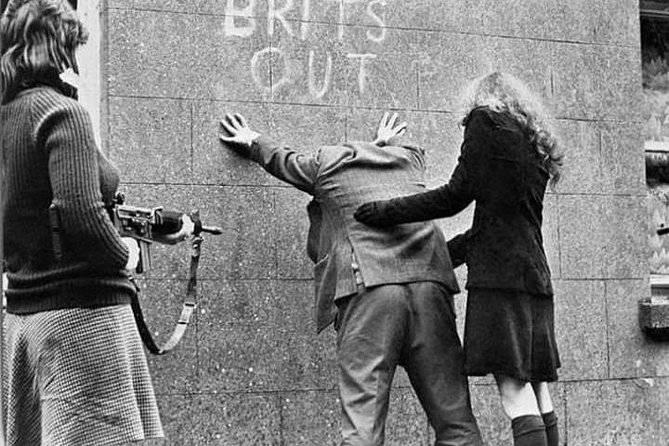
Clonard is one of the most emotionally heavy stops. The memorial garden commemorates Republican volunteers, civilian victims, and Republican prisoners from the wider Clonard area, covering deaths from 1916 through the modern conflict.
The entrance has black iron gates and a rising phoenix, with the message that the Provisionals arose from the ashes. Inside, the garden is divided into three yards. A central Celtic cross is surrounded by memorial plaques, names, provincial symbols, benches, and inscriptions connected with the Republican cause.
The site also refers to the burning of Bombay Street in 1969. Loyalist attacks forced Catholic residents from their homes, and much of the street was destroyed. The first peace walls were built around this period as a way to keep communities apart.
You should allow yourself time to read rather than simply take a photograph. The listed stop lasts about 30 minutes, making it one of the longer visits. Some people may find the wording strongly partisan, especially plaques that honor resistance to British rule and describe a hoped-for united Ireland. That is precisely why the guide’s explanation matters, but it is also why visitors seeking a neutral memorial should temper expectations.
Milltown Cemetery and the Bobby Sands grave
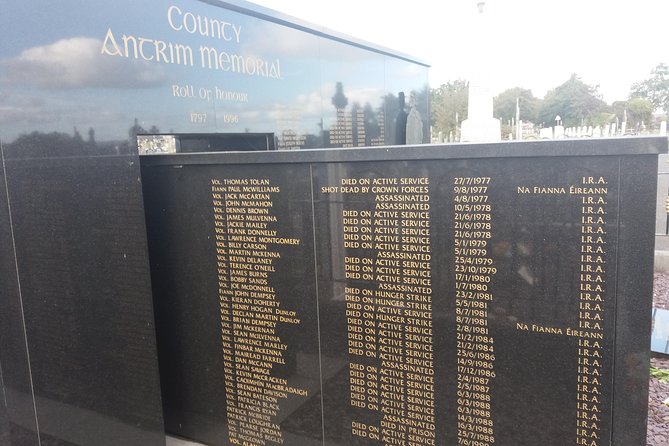
Milltown Cemetery gives the tour a quieter setting, although the subject remains intense. You visit the Republican plots, which contain volunteers killed in different periods, including the 1920s, the Northern Campaign of the 1940s, and the later conflict.
The cemetery is also associated with Bobby Sands, the Provisional IRA prisoner who died on hunger strike in 1981 after 66 days. He had been elected as a Member of Parliament while in prison, and his death became a major international symbol of the hunger strikes.
The Republican plots are marked with red hands, and the New Republican Plot contains 77 IRA volunteers, including Máiread Farrell. Your guide explains how the National Graves Association cares for these sites and how annual commemorations continue.
This stop is listed at about 25 minutes, and one rating specifically found that time at the cemetery a little long. I can see both sides. If you care about the conflict, the cemetery rewards close attention. If you mainly want murals and city views, the pace may feel slow compared with the number of other stops packed into three hours.
The vehicle makes the visit easier for anyone who wants to bring flowers or pay respects at a particular grave. One guide has even stopped at a flower shop for a family carrying out that personal task.
Bobby Sands murals and hunger-strike history
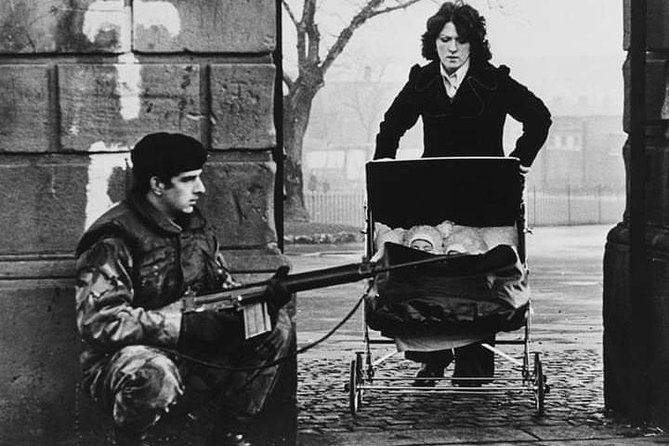
The tour visits the famous Bobby Sands mural and other Republican memorials. You hear about the blanket protest, the dirty protest, and the 1981 hunger strike, as well as the other hunger strikers whose photographs appear at the site.
These murals work best when you know what they refer to. The hunger strike was linked to the removal of Special Category Status for Republican prisoners, who wanted to be treated as political prisoners rather than ordinary criminals. The subject remains contested, and the guide presents the Republican interpretation of imprisonment, resistance, and sacrifice.
The route also includes the Second Battalion IRA Garden of Remembrance, associated with the area’s D Company, sometimes known by the nickname The Dogs. Another Garden of Remembrance honors the Belfast Brigade, which was organized into battalions covering areas such as Falls Road, Clonard, Ballymurphy, Ardoyne, the Markets, and Short Strand.
These are not casual photo stops. The names and symbols carry meaning for local families. You can take photographs, but the most useful approach is to listen first and photograph second.
The private Irish Republican history museum
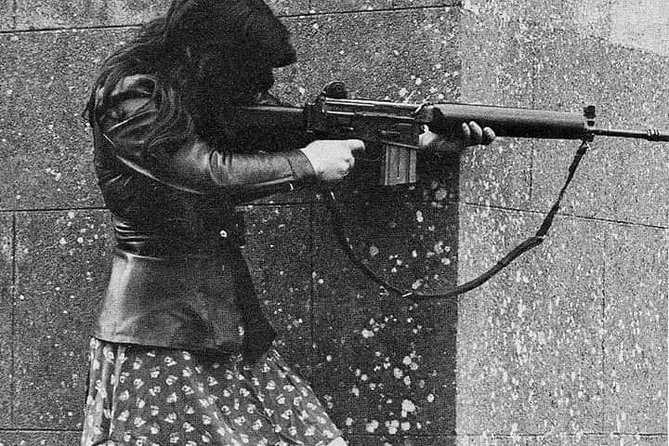
The museum is the tour’s most unusual feature. The Eileen Hickey Irish Republican History Museum is a small private collection devoted to resistance, imprisonment, and the Republican struggle across centuries of Irish history.
Access is not part of every ordinary Belfast sightseeing route. The museum normally opens from 10 a.m. to 2 p.m., Tuesday through Saturday. If it is closed, the guide substitutes a tour around Ballymurphy, so you should confirm the museum schedule when choosing your time.
The collection includes material connected with the conflict, and the tour description specifically mentions handling plastic and rubber bullets used by British Crown forces. Former prisoners may also share their experiences when available. That personal contact can give the museum more force than a display case alone.
Do not expect a large national museum with polished galleries and extensive labels. The appeal is its personal, political character. The material is presented within a Republican account, and you should treat it as a perspective-based collection rather than a final word on Northern Ireland.
Clonard Monastery, Divis Tower, and Ballymurphy
Clonard Monastery sits near the interface between the Falls and Shankill districts. Priests from the Redemptorist community worked to protect residents and support peace efforts during the conflict. The monastery was also associated with Fathers Alec Reid and Gerry Reynolds, two clergy members involved in peace work.
The stop is brief, around 10 minutes, but it adds an important angle. Not every story here is about armed groups. Religious figures also tried to protect people, open channels of communication, and reduce violence.
At Divis Tower, you see the high-rise overlooking the Falls. The British Army used a sniper position and observation post there until 2005, according to the tour material. The tower also has links to the first two victims of The Troubles.
The vehicle then passes through Ballymurphy, with murals about the Great Famine and local volunteers. The route includes a mural to Jim Bryson and his nickname, Big Louie, a machine gun associated with Republican activity. These very local references are hard to understand without a guide, which is one reason the private format works well.
Timing, transport, and value at $255.50
The price is $255.50 per person for about three hours. That is a serious price for a short Belfast tour, but you are paying for private transportation, hotel pickup in central Belfast, a dedicated guide, and access to places that are not part of standard group routes.
The value improves if you are a small group that wants to ask many questions. A guide can change the emphasis, spend longer at a memorial, or discuss a family connection without holding up a bus full of strangers. Several guides are described as tailoring the route to the group, and one adjusted destinations as conversation developed.
The price is harder to justify if you only want a quick mural drive. Many of the stops last five or 10 minutes, and the route covers so much ground that some explanations will be brisk. A cheaper shared taxi tour may suit you better if you want a broad introduction.
Pickup is free from the central Leonardo Hotel meeting point. Extra charges apply for several other locations, including the cruise port, Titanic Belfast, Crumlin Road Gaol, Queen’s University, the Botanical Gardens, and the Ulster Museum. Cruise pickup and drop-off cost £25 each way, and airport pickup is not offered.
You can also request a luxury Mercedes V-Class upgrade for £25 when available. That is optional, not part of the core experience.
Which guide and point of view should you expect?
The named guides include Barry, Paula, Joe, Ciarán, Brendan, and others. The guide you receive depends on the booking and schedule, so you should not assume that a particular person is guaranteed unless the operator confirms it.
Barry is described as an Irish history specialist with university study at Queen’s University Belfast. Paula is praised for combining personal stories with clear explanations, while Joe is described as sharing direct memories of Belfast during The Troubles. Ciarán is noted for driving a rare white cab and making stops for photographs. These details suggest a local, personality-led experience rather than a scripted museum tour.
Accent and communication are worth considering. One rating found a guide difficult to understand, though this appears to be an isolated concern among otherwise strong feedback. If you have hearing difficulty or are unfamiliar with Northern Irish accents, ask questions early and request clarification when needed.
The overall rating is 4.9 from 67 ratings, with 97 percent recommending the tour. The most praised qualities are the guides’ personal connection, broad command of Irish history, friendly manner, flexibility, and ability to explain a great deal in three hours.
Who should book this tour?
Book it if you want a direct Republican account of Belfast and prefer local testimony to a neutral audio guide. It suits people with a serious interest in Irish history, political murals, the hunger strikes, peace walls, cemeteries, and the continuing effects of division.
It also works well for families or private groups who need flexibility. You can ask about a relative, request a photograph, discuss a book or film, or spend more time on a site that matters to you.
Think twice if you want a balanced account of all sides. The tour does discuss Loyalism and British involvement, but it does so within a Republican narrative. You should choose a different tour, or add one, if you want equal treatment of Unionist, Loyalist, Nationalist, Republican, and British perspectives.
Should you book it?
I would book this tour for its access and focus, not because it gives the final word on Belfast. The private museum, Milltown Cemetery, Clonard memorials, and neighborhood murals offer a level of contact that a standard city tour usually cannot match.
At $255.50 per person, it makes the most sense for a small group that values time for questions and personal guiding. Go in knowing the political angle, check the museum hours, confirm pickup costs, and allow yourself to hear a strong point of view. If that is what you want, this can be one of the most memorable history experiences in Belfast.
FAQ
How long does the tour last?
The tour lasts approximately three hours.
What perspective does the guide present?
The tour focuses on Irish Republican history and presents The Troubles mainly from a Republican perspective. It is not described as a balanced account of Republican, Loyalist, and British viewpoints.
Is hotel pickup included?
Free pickup is offered from the central Leonardo Hotel meeting point. Extra charges apply for some other locations, including the cruise port and several Belfast attractions.
Is the Irish Republican History Museum always open?
No. The museum normally opens from 10 a.m. to 2 p.m., Tuesday through Saturday. If it is closed, the tour includes Ballymurphy instead.
Does the tour visit Bobby Sands’ grave?
Yes. The route visits Milltown Cemetery and the Republican plot, including Bobby Sands’ grave.
Can I write on the Peace Wall?
Yes. The tour includes a visit to both sides of a Peace Wall, where you can sign your name and write a message of peace.
Is transportation provided?
Yes. Private transportation in an air-conditioned vehicle is included. A luxury Mercedes V-Class upgrade may be available for an additional £25.
Just added in Belfast
- Black Taxi Tour and Crumlin Road Gaol tour Combo★ 5.0 · 170 reviews
- The Troubles and iconic award winning taxi 2hr private cab tour★ 5.0 · 28 reviews
- Black Taxi Mural “Tour Like A Local”★ 5.0 · 125 reviews
- 2 hours Belfast Original Drivers The Troubles Black Taxi Tour★ 5.0 · 227 reviews
- World Famous Belfast City Centre Black Cab/Taxi Tour 2 Hours★ 4.5 · 177 reviews
- Belfast Music and Street Art Small Group Guided Experience★ 4.5 · 62 reviews
- Iconic Belfast Black Cab Tour★ 5.0 · 449 reviews
- McConnell’s Distillery Experience with Tasting★ 5.0 · 278 reviews
Museums, compared.
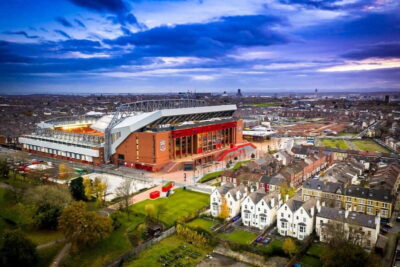
Liverpool Football Club Museum and Stadium Tour
Read our review →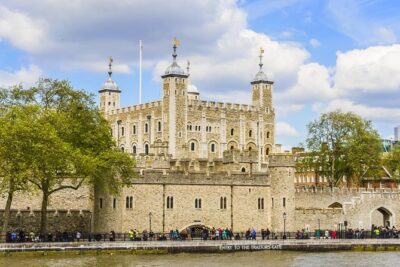
Tower of London and Crown Jewels Exhibition Ticket
Read our review →
Chelsea Football Club Stadium and Museum Tour
Read our review →


Browse the lists this tour appears in