
Reviewed · MUSEUMS
Explore Biblical Artifacts at the British Museum
The most useful feature of this British Museum tour is its clear biblical timeline. Guide David connects Assyrian lamassu, Egyptian pharaohs, Greek sculpture, Persian and Babylonian objects, Roman coins, and New Testament figures to specific Bible passages. You are not simply looking at ancient objects. You are learning how they fit into the world described by Scripture.
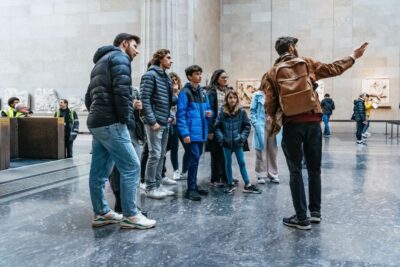
I like the small group of no more than 10 people, which gives David room to answer questions and adjust the route. I also like the Google Doc with study notes and Bible verses, plus the practical tip about borrowing a folding stool for long periods on the museum floor. The main drawback is pace: three or four hours is a long time for a museum tour, and the subject is best suited to people who already want a Bible-centered reading of ancient history.
Key points to know before you book
- David builds a biblical timeline: Joseph, Moses, Jonah, Ahab, Hezekiah, Jesus, and Paul all become part of the tour’s story.
- The route covers major ground-floor galleries: Expect Assyrian, Egyptian, and Greek collections before moving upstairs to Roman displays.
- A study guide adds value: You receive a Google Doc with background notes and related Bible verses, and a Bible app that works offline is recommended.
- The group is capped at 10 people: That makes it easier to hear the guide and ask questions in crowded galleries.
- Plan a half day: The tour usually takes three to four hours, though an especially engaged group may run longer.
- A stool can make a real difference: Folding stools are available at the museum for anyone who finds prolonged standing tiring.
Why this tour changes the way you see the British Museum
The British Museum can feel like a giant warehouse of disconnected civilizations. One room gives you Egyptian sculpture, the next presents Assyrian reliefs, and somewhere upstairs you find Roman objects linked to the New Testament. Without a plan, it is easy to admire the art but miss the connections.
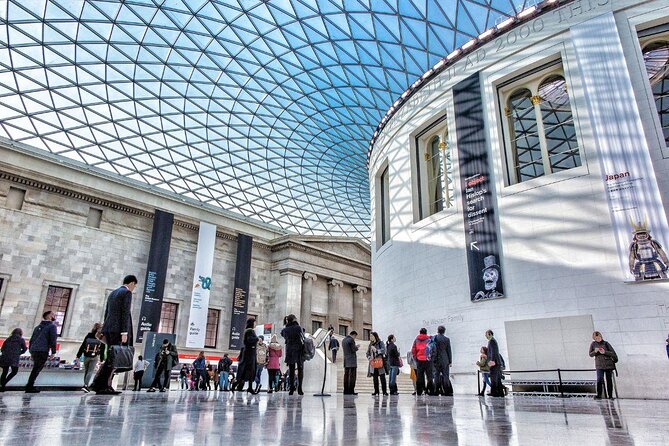
David’s approach gives those rooms a clear order. He moves from the ancient Near East and Egypt toward Assyria, Babylon, Persia, Greece, and Rome. That sequence helps you place biblical figures in time rather than treating the Bible as a loose collection of stories.
The emphasis is firmly biblical. David refers to specific passages and uses the museum’s objects to explain the political and cultural setting behind them. That makes the experience especially useful if you want to see the Bible in relation to actual rulers, empires, writing systems, weapons, coins, and religious objects.
I would not choose this tour if you want a neutral art-history survey of the entire museum. You will see only selected galleries, and the discussion is shaped around Scripture. For a Bible reader, that focus is the point. For someone mainly interested in Greek sculpture or Egyptian art, a standard museum tour may serve you better.
More Museum Tours in England
- Afternoon Tea at the British Museum
★ 4.2 · 511 reviews - British Museum Guided Tour
★ 4.0 · 470 reviews - British Motor Museum Entry Ticket in Gaydon
★ 5.0 · 288 reviews
Assyrian lamassu and the world of Jonah and Hezekiah
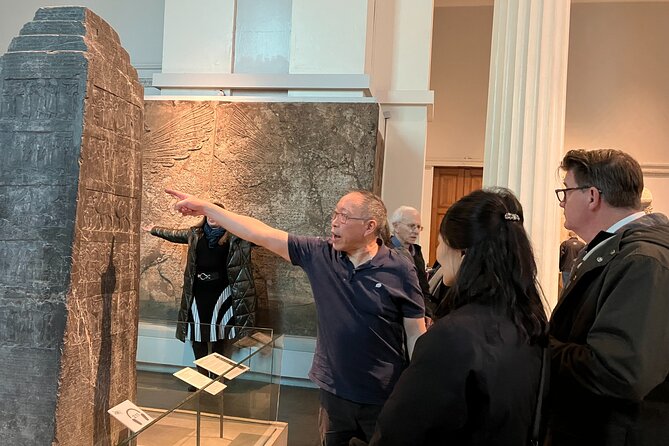
The tour begins on the ground floor with the Assyrian galleries. The large lamassu are an immediate attention grabber. These winged, human-headed beasts weigh about 40 tons, and their size gives you a physical sense of the power Assyria wanted to project.
Here, David links the Assyrian collection to biblical figures such as Jonah, Ahab, and Hezekiah. The value is not just in hearing a familiar name. You can see the kind of imperial culture that surrounded Israel and Judah, then connect that setting with the conflicts described in the Old Testament.
The Assyrian displays also reward close looking. Details in reliefs, city gates, rulers, and inscriptions can be easy to miss when you walk through alone. One particularly useful point raised on the tour is the detail of bronze bands on a city gate, an example of how a small object can help you picture ancient construction and military power.
This section can be intense because there is a lot to cover. David is trying to build a long timeline, so you may move between objects and Bible passages at a brisk pace. The study notes help, but I would avoid arriving without at least a basic sense of the Old Testament books being discussed.
Egyptian statues and the stories of Joseph and Moses
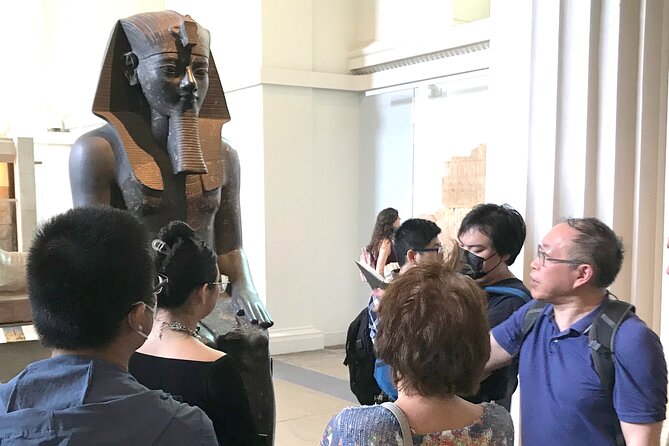
The Egyptian galleries add another layer to the early part of the tour. You will see statues of famous pharaohs and consider Egypt as the setting for Joseph and Moses.
The tour does not turn every statue into a direct portrait of a biblical person. Instead, it uses the objects to explain royal power, religious belief, and the culture in which those stories take place. That distinction matters. The museum’s objects help you understand the era, but they do not automatically prove every detail of a biblical account.
This is one reason the experience works best when David gives context before pointing to a display. A pharaoh’s statue can seem remote when viewed alone. Placed within a discussion of kingship, slavery, state religion, and the movement of peoples, it becomes easier to picture the world behind the text.
The Egyptian galleries are also one of the more familiar parts of the British Museum. If you have already seen them, David’s biblical framing may give you a new reason to look again. If this is your first visit, expect to spend only part of your museum day here rather than seeing every major Egyptian object.
Greek sculpture and Paul’s wider world
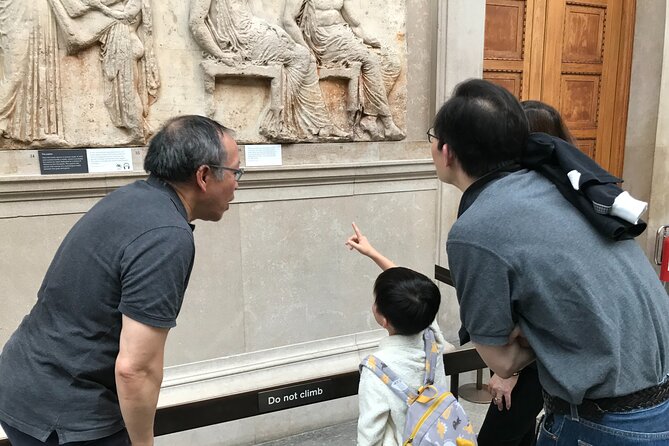
The route continues to the Greek galleries, including the Parthenon sculptures from Athens. These famous works are worth seeing even if your main interest is biblical history, but the tour treats them as part of a larger cultural setting rather than as an isolated art lesson.
Paul’s connection to the Greek world becomes important here. His journeys and writings make more sense when you understand the language, cities, public spaces, and artistic traditions of the eastern Mediterranean. The Greek galleries give David material for explaining the culture Paul encountered and the intellectual world in which early Christianity spread.
This section also shows the limits of a half-day tour. The British Museum has far more Greek material than any small group can cover. David selects objects that support the biblical timeline, so you get a focused route instead of a full survey of Greek art.
I like that trade-off. A first-time visitor can easily spend hours wandering through the Parthenon room without knowing what to prioritize. A guide who chooses a few useful examples can make the collection easier to remember. The cost is that you will not receive equal attention to every civilization or gallery.
Same trip, a completely different kind of day:
- Thorpe Park Admission Ticket
★ 4.0 · 5,915 reviews - Alton Towers Resort 1 Day Admission Ticket
★ 3.5 · 5,501 reviews - Warwick Castle Admission Ticket
★ 4.0 · 2,096 reviews - The Great British Rock and Roll Walking Tour
★ 5.0 · 1,371 reviews
Roman galleries, Jesus, Paul, and the evidence of coins
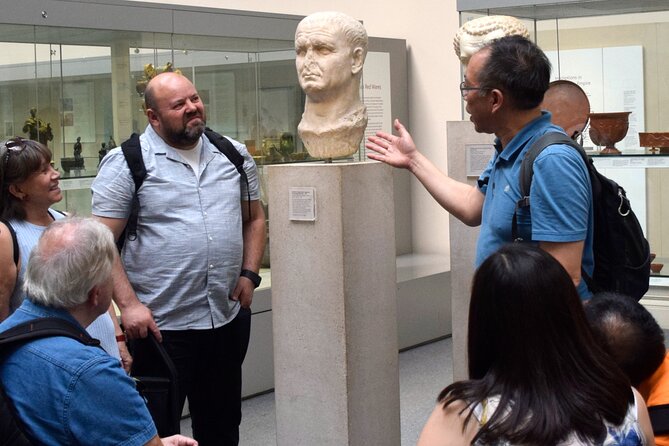
After a break, the group goes upstairs to the Roman galleries. This is where the New Testament portion of the tour becomes more direct. David discusses Roman emperors and objects connected with the period of Jesus and Paul.
Coins are especially helpful here. One of the tour’s memorable details is the chance to see the faces of Roman leaders who were part of the political world surrounding the crucifixion. You can also examine the kinds of coins used during the time of Jesus, giving a concrete feel to passages that refer to money, taxes, rulers, and authority.
The Roman section also helps connect the Old Testament timeline to the New Testament. Instead of ending with Israel’s earlier encounters with Assyria, Babylon, and Persia, the tour continues through Greek influence and into Roman rule.
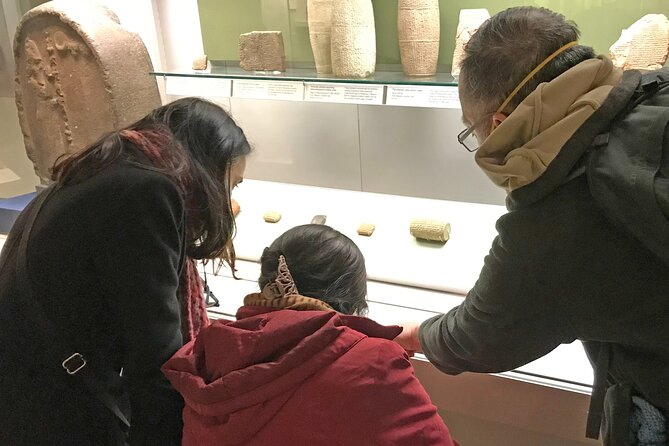
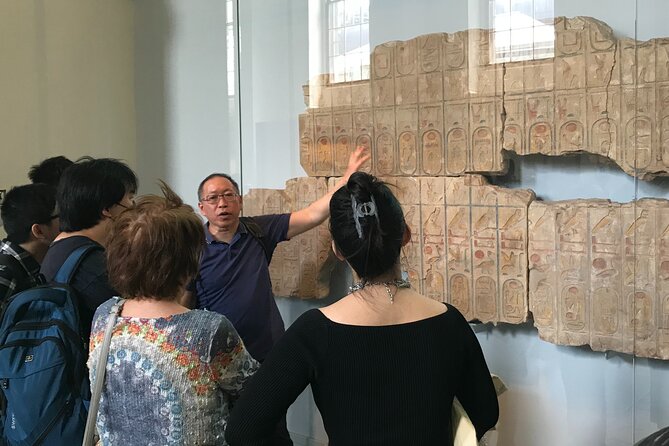
David may point out objects or details that you would otherwise walk past. He also answers side questions, such as how to read a cartouche or how a Persian king’s rhyton was used to pour wine. These details are not always central to the main story, but they make the museum feel less like a set of glass cases and more like a collection of objects made for daily life, government, ritual, and war.
Persian and Babylonian galleries when time allows
Persian and Babylonian displays may be included depending on time and group preference. This flexibility is useful, but it also means you should not assume that every possible gallery will receive equal attention.
These sections matter because they fill in important parts of the Old Testament story. The tour uses the objects to discuss the Israelites’ interactions with major empires, including triumph, defeat, exile, and political change.
If Babylonian or Persian material is your main interest, tell David early. The route can shift when galleries close early or when the group wants to spend longer with a particular display. That flexibility has been useful when the museum schedule changes, but it also reinforces the need to treat the advertised route as a framework rather than a minute-by-minute promise.
David’s teaching style and the small-group advantage
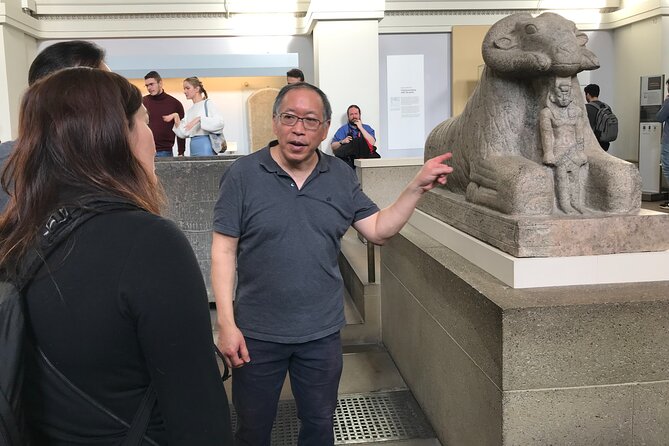
David’s strongest quality is his ability to keep a long sequence understandable. He gives the group a starting framework, then adds rulers, places, objects, and Bible references without losing the main thread.
He also uses questions during the tour, which helps prevent the experience from becoming a nonstop lecture. His humor and enthusiasm are useful in a museum where hard floors, warm galleries, and dense information can wear you down.
The small group makes a practical difference. With a maximum of 10 people, you can hear the explanation more easily and ask about a detail that caught your attention. The group can also spend longer at an object if several people want clarification.
The tour can sometimes run close to five hours if the group asks many questions and wants extra material. That may be a bonus for serious Bible students, but it is not ideal if you have a timed afternoon plan. Leave room afterward rather than booking another fixed activity immediately.
Study notes, Bible apps, and how to prepare
The Google Doc is one of the best parts of the experience because it gives you something to use before and after the museum visit. It contains study notes and related Bible verses, so you can arrive with a basic map of the material.
You are also encouraged to install a Bible app that works in airplane mode. YouVersion is suggested. This matters because David may ask you to read or compare passages while standing beside an artifact, and a working offline app avoids relying on a mobile signal.
I would read at least some of the notes before meeting the group. Even a quick review of the names and time periods will help you follow the transitions from Egypt to Assyria, Greece, and Rome.
Afterward, David may send additional references and clarification on topics discussed during the tour. That follow-up is useful if you want to continue studying instead of letting the material disappear once you leave the museum.
The price, duration, and practical trade-offs
The listed price is $77.50 per person, with group discounts available. The experience lasts about three to four hours, and the museum admission is shown as free. Since the tour takes place inside the British Museum, the price is paying for David’s time, planning, teaching, and focused route rather than for an expensive entrance ticket.
That can be good value if you would otherwise wander without knowing what to see. The British Museum is large, and a focused guide can save you time while giving the collection a clear purpose. The study notes and follow-up material add value beyond the hours spent inside the galleries.
The price may feel high if you only want a quick introduction or if your interest in biblical material is casual. It is also possible to visit the museum without this tour, so the decision rests on how much you value guided interpretation.
The museum visit requires stamina. You may spend long periods on hard floors, although folding stools are available to take along. One teen-focused group found some galleries uncomfortably warm, so plan for changing conditions and bring water if allowed by museum rules.
Meet at the British Museum on Great Russell Street, London WC1B 3DG. The tour finishes back at the meeting point. It is offered in English, uses a mobile ticket, and is near public transportation. Service animals are allowed, and most people can participate.
Do not schedule this as your first activity after a long-haul flight. The pace and concentration required are better suited to a rested morning or afternoon. After the tour, you still have the rest of the day for London, provided you do not let the museum discussion run long.
Who should book this British Museum experience?
I would choose this tour if you want Bible passages tied to physical objects and ancient political settings. It is a strong match for church groups, Bible study groups, families with older children or teenagers, and visitors who want more than a general museum walk.
It also suits people who enjoy timelines and cross-references. You will hear about Joseph, Moses, Jonah, Ahab, Hezekiah, Jesus, and Paul while moving through several ancient cultures. That broad span is rewarding if you like seeing connections across the Old and New Testaments.
I would think twice if you prefer an archaeological tour that separates museum evidence from religious interpretation. The guide presents the collection through a biblical lens, and that shapes both the objects selected and the explanations offered.
Should you book it?
Book this tour if the Bible is a central reason you want to visit the British Museum. David’s route turns a huge collection into a readable story, and his use of verses, rulers, coins, reliefs, and sculpture gives you plenty to examine after you leave.
Skip it if you want a short, general introduction to the museum or a full survey of its collections. For everyone else, the small group, offline study tools, optional stool, and carefully linked timeline make $77.50 a reasonable price for a focused half day in London.
FAQ
How long does the tour last?
The tour lasts approximately three to four hours. If the group asks many questions or spends extra time with the displays, it may run longer.
Where does the tour begin?
It begins at the British Museum, Great Russell Street, London WC1B 3DG, United Kingdom.
Where does the tour end?
The activity ends back at the British Museum meeting point.
Is admission to the British Museum included?
The tour information lists the admission ticket as free. The experience itself costs $77.50 per person.
How many people can join the tour?
The maximum group size is 10 people.
What languages are offered?
The tour is offered in English.
What Bible-related figures are discussed?
The tour discusses Joseph and Moses in connection with Egypt, Jonah, Ahab, and Hezekiah in connection with Assyria, and Jesus and Paul in connection with the Roman and Greek worlds.
Should I bring a Bible app?
Yes. A Bible app that works in airplane mode is recommended, and YouVersion is suggested. The tour also provides access to a Google Doc with study notes and related Bible verses.
Can I cancel for a full refund?
You can cancel at least 24 hours before the experience start time for a full refund. Cancellations or changes made less than 24 hours before the start time are not accepted for a refund.
Just added in England
- British Museum Highlights Private Guided Tour★ 5.0 · 29 reviews
- Heathrow Airport to Southampton Port or Hotel Private Airport Arrival Transfer★ 5.0 · 45 reviews
- Heathrow To Southampton Cruise Port Transfers★ 4.5 · 110 reviews
- Private Guided Tour of the British Museum★ 5.0 · 50 reviews
- British Royal 3 Hour Walking Tour!★ 4.5 · 53 reviews
- British Museum Guided Tour with Priority Timeslots(Small Group)★ 5.0 · 192 reviews
- British Museum In-Depth Private Guided Tour★ 5.0 · 40 reviews
- Private Guided Tour of Harry Potter Locations – English/ Italian★ 5.0 · 33 reviews
Museums, compared.

Liverpool Football Club Museum and Stadium Tour
Read our review →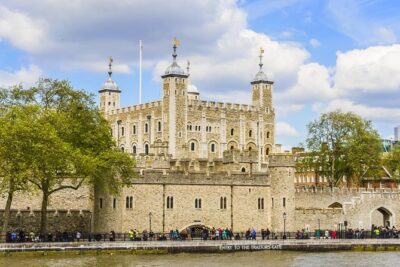
Tower of London and Crown Jewels Exhibition Ticket
Read our review →
Chelsea Football Club Stadium and Museum Tour
Read our review →

Browse the lists this tour appears in