
Reviewed · LITERARY TOURS
Shakespeare’s Schoolroom and Guildhall Entrance Tickets
Shakespeare’s Schoolroom and Guildhall gives you something most Shakespeare attractions cannot: a place connected to his ordinary childhood. You sit in the room where he studied as a boy in the 1570s, then take part in a lively Tudor lesson led by Master Thomas Jenkins. I like the quill-writing activity and the chance to see the old priest’s chapel, with its carefully conserved medieval wall painting.
I also like that this is not only about Shakespeare. The building itself, dating from 1420, tells the story of a medieval Guildhall and later theatrical performances. The drawback is its size: the visit lasts about an hour, and the rooms are compact, so anyone expecting a large museum or a long theatrical show may find it brief.
Key points to know before you go
- Sit where young Shakespeare studied: The schoolroom places you in the setting of his education in 16th-century Stratford.
- Meet Master Thomas Jenkins: The Tudor schoolmaster leads a period lesson with Latin, discipline, and old-style teaching methods.
- See a rare medieval wall painting: The former priest’s chapel contains a recently conserved artwork.
- Try quill writing at Shakespeare’s desks: This hands-on activity gives children and adults a feel for Tudor schoolwork.
- Explore a Guildhall built in 1420: The lower rooms explain the building’s medieval civic and religious roles.
- Allow one focused hour: At $20 per person, the visit works best as a compact historical stop in central Stratford.
Why Shakespeare’s schoolroom matters
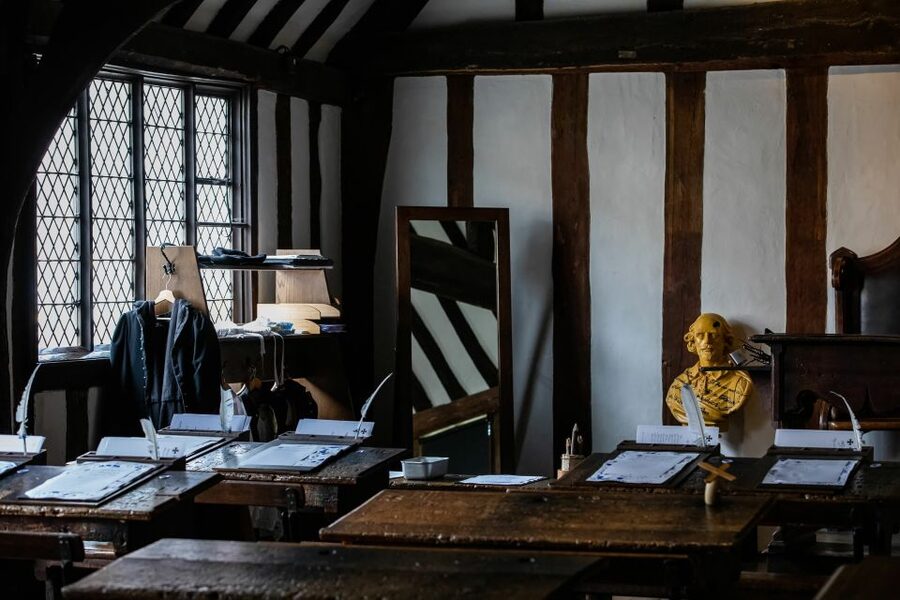
William Shakespeare is often presented as a finished genius, already waiting to write plays. This visit helps you picture something more ordinary and more useful: Shakespeare as a local schoolboy in Stratford-upon-Avon.
The schoolroom connects his later work with the subjects he may have encountered as a pupil. You learn about classical literature, Tudor teaching methods, and the role of Latin in education. You also hear how the building was connected with theatrical performances, including appearances by some of the country’s finest actors.
That link matters. Shakespeare did not grow up in a cultural vacuum. His education gave him access to classical stories and language, while performances in his home town offered a direct look at the stage. The visit does not pretend to solve every mystery about his early life. Instead, it fills in a useful part of the story between his childhood and his later career.
I find this setting more effective than a display of objects behind glass. Sitting at the desks puts the subject at human scale. You are not just hearing that Shakespeare went to school in Stratford. You are looking at the room where that school life took place.
More Literary Tours in Stratford-upon-Avon
- Shakespeare Distillery Tour – 1pm Ticket
★ 5.0 · 598 reviews - The Sinister Side of Shakespeare’s Stratford Walking Tour
★ 4.8 · 547 reviews - Shakespeare’s Globe Guided Tour
★ 4.5 · 481 reviews
Entering the 1420 Guildhall
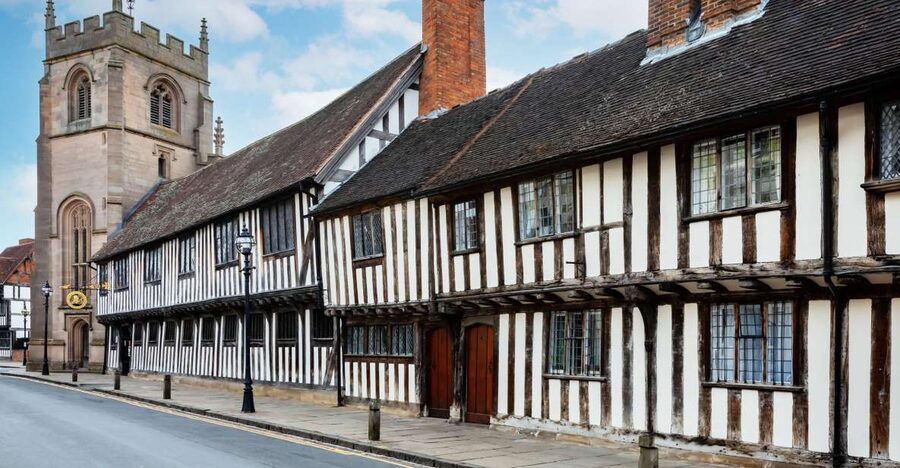
The Guildhall is the older story here. Built in 1420, it is one of only a small number of medieval Guildhalls still surviving in Britain. Its age gives the visit a second focus beyond Shakespeare.
The lower part of the building explains its role as a medieval provincial Guildhall. This was a place linked to civic life, local authority, and religious activity. The building later became part of Stratford’s cultural world, which helps explain why Shakespeare could encounter professional actors in the same setting connected with his town.
Do not expect a vast medieval complex. The attraction is compact, and one section of the visit may feel more like an introduction than a full museum tour. Still, the limited scale has an advantage: you can focus on the building’s physical details without racing through a large collection.
The old timbers, rooms, and changing uses give you a sense of how one building could serve several parts of town life. The Guildhall is not simply a backdrop for the Shakespeare story. It is the reason that story feels rooted in a real place.
The medieval chapel and its wall painting

One of the quieter highlights is the late medieval priest’s chapel. Here you can see a rare wall painting that has recently been conserved.
This is the kind of detail that can be easy to miss if you come only for Shakespeare. Take a moment to look closely. The painting links the building to its religious past and reminds you that the Guildhall was not designed as a schoolroom or theater attraction. Its original purpose belonged to a different Stratford.
The chapel also gives the visit some visual variety. The schoolroom is lively and hands-on, while the chapel asks you to slow down and look. If you are interested in medieval art, this may be the most important part of the building. If you have young children with you, it may be less immediately exciting than the costume and writing activities, but it still gives useful context.
Taking a Tudor lesson with Master Thomas Jenkins
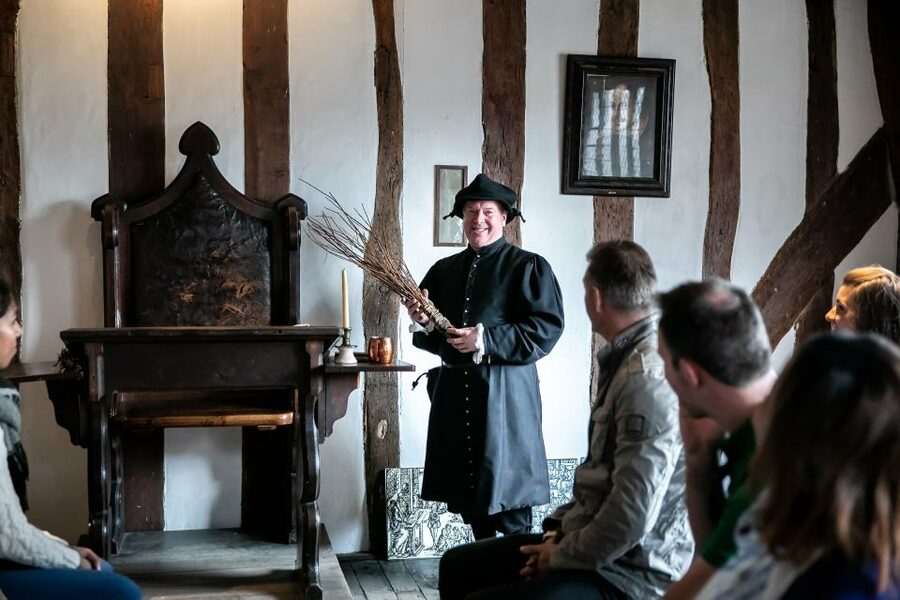
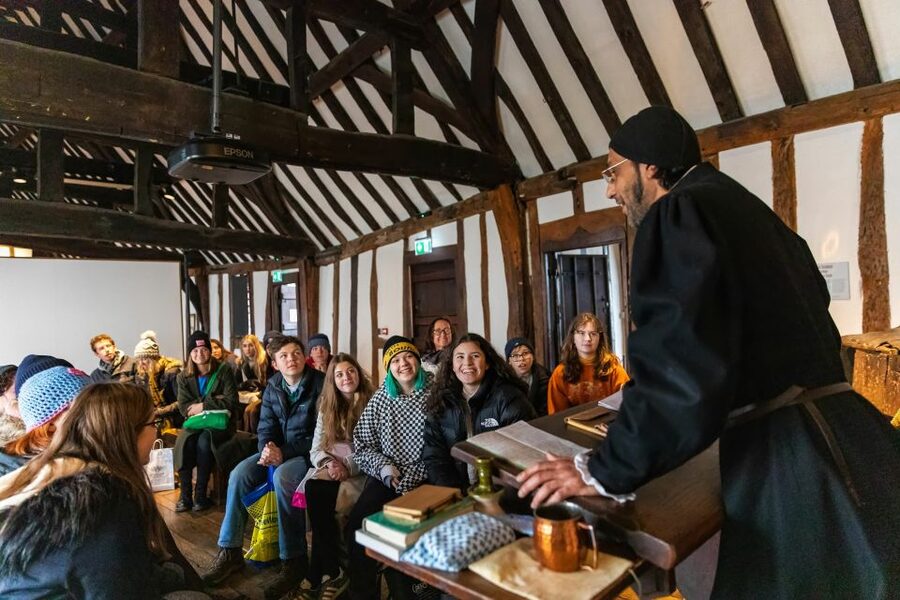
The main event is the lesson with Master Thomas Jenkins. He appears as a Tudor schoolmaster and brings a strong theatrical quality to the hour without turning the whole visit into a stage show.
You learn how a pupil in Shakespeare’s time might have been taught and what subjects mattered. Latin is central to the presentation, and the teaching style helps you picture the strict, formal world of a 16th-century classroom. The period character is larger than life, which makes the lesson easier to follow for children and more entertaining for adults.
This section receives the strongest praise for good reason. It turns information into an activity. You are not simply told that Tudor schools used different methods. You see those methods presented through a character, a classroom, and a lesson.
The exact mood will depend on the group and the guide, but the format is clearly designed for participation. Families should find it especially useful because the lesson gives children something to watch and respond to. Adults without children should not feel left out. The historical setting and dry humor are aimed at the whole room.
The lesson also helps explain why Shakespeare’s later writing had such a strong connection with classical ideas and language. You do not need a specialist background in literature to follow it. The point is to show how education shaped the young man who later became one of the world’s most famous writers.
More Literary Tours in Stratford Upon Avon:
- Stratford-upon-Avon: Shakespeare’s Birthplace Ticket
★ 4.6 · 476 reviews - From London: Shakespeare’s Stratford-upon-Avon Day Trip by Coach
★ 4.5 · 352 reviews - The Sinister Side of Shakespeare’s Stratford Walking Tour
★ 5.0 · 279 reviews - Shakespeare’s Schoolroom & Guildhall Entry Ticket and Tour
★ 5.0 · 232 reviews
Quill writing at Shakespeare’s old desks
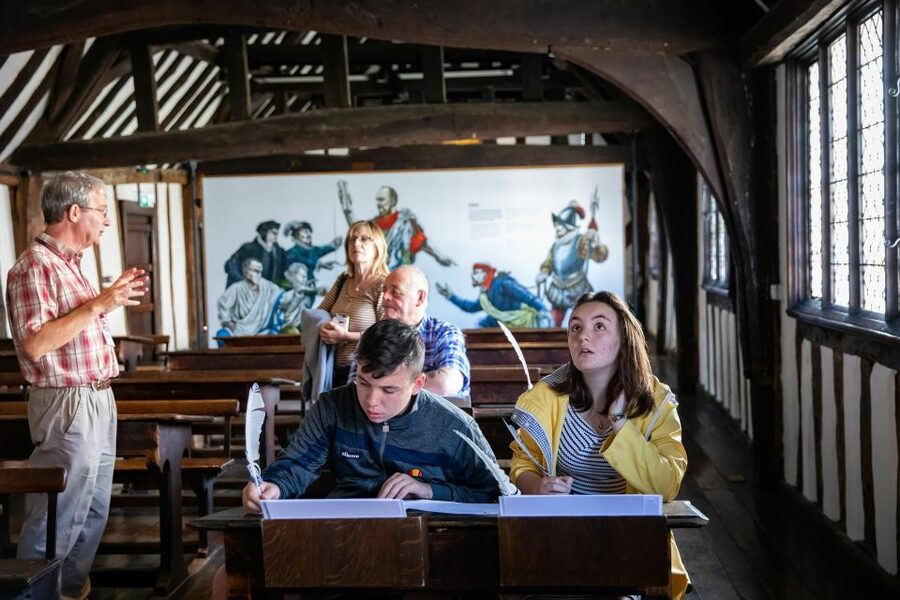
After the lesson, you can practice writing with a quill. This is a small activity, but it makes the schoolroom memorable.
A quill is not just a decorative prop here. It gives you a physical sense of the work involved in writing before modern pens and keyboards. The desks are presented as the sort of desks that may have been used by a young William Shakespeare, so the exercise connects your hands with the room’s main story.
I like this activity because it works for different ages. Children can treat it as a game, while adults can think about the patience and skill required for written work in the Tudor period. It also breaks up the spoken explanation and gives you a chance to take part rather than simply listen.
You should not expect a full handwriting workshop. It is a short experience within the wider visit. Its value comes from the setting, not from producing a perfect piece of calligraphy.
Tudor clothes and games
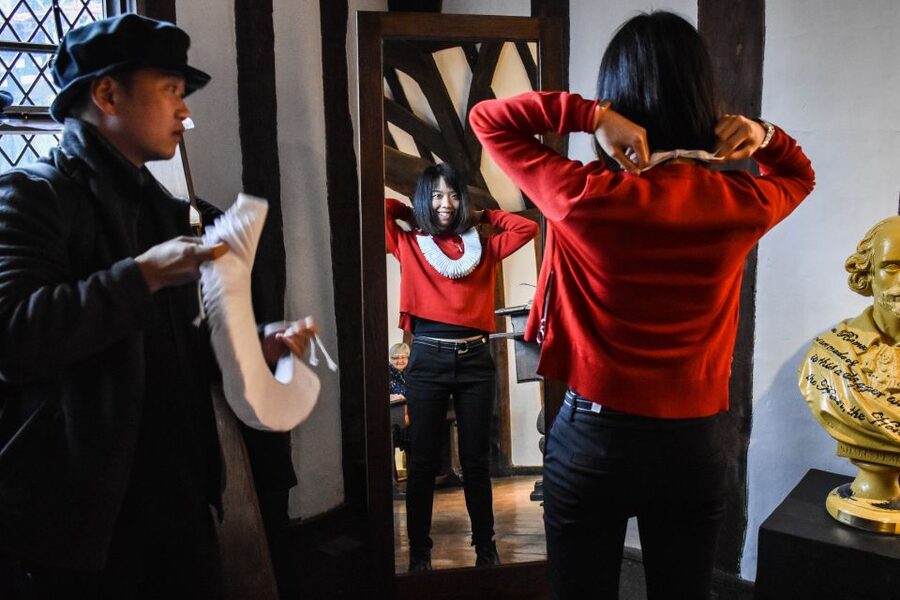
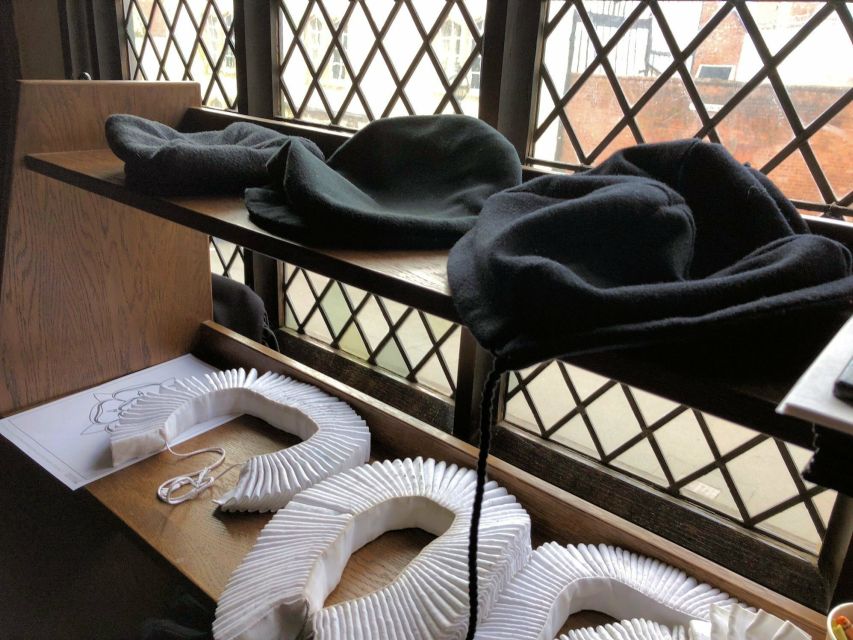
The attraction also offers Tudor-style clothing and games. These features help younger visitors take part, but they are not limited to children.
Period clothing can make the schoolroom feel less like a preserved building and more like a place with people in it. Tudor games offer a simple way to connect with everyday leisure from the period. The details are less important than the change in mood: after hearing about education and medieval civic life, you get a chance to play.
Families should allow time for this part instead of hurrying straight out after the lesson. If your group includes children, the chance to dress up may be one of the most anticipated parts of the visit. Adults who prefer quiet historical interpretation may find it less essential, but you can still enjoy the atmosphere without taking part in every activity.
The attraction is at its best when it balances these playful elements with the building’s serious history. The costumes and games draw you in, while the chapel, Guildhall, and schoolroom give the visit substance.
The short film and guided explanations

A short film by historian and broadcaster Michael Wood covers the Guildhall’s history. It provides a useful overview before or alongside the rooms themselves.
The film is especially helpful if you know little about Stratford’s medieval past. Rather than leaving you to guess why the building matters, it sets out the main story in a clear format. The guides then add personal explanation, anecdotes, and practical context.
The staff are described as passionate and kind, and that matters in a small attraction. A good guide can make a compact room feel full of detail. The strongest moments come when the guide links the physical building to Shakespeare’s education, the town’s theater life, and the building’s earlier religious role.
The presentation is in English. If you are not comfortable following spoken English, the lesson and guided explanations may be harder to appreciate, since much of the experience depends on character, humor, and verbal storytelling.
How much time should you allow?
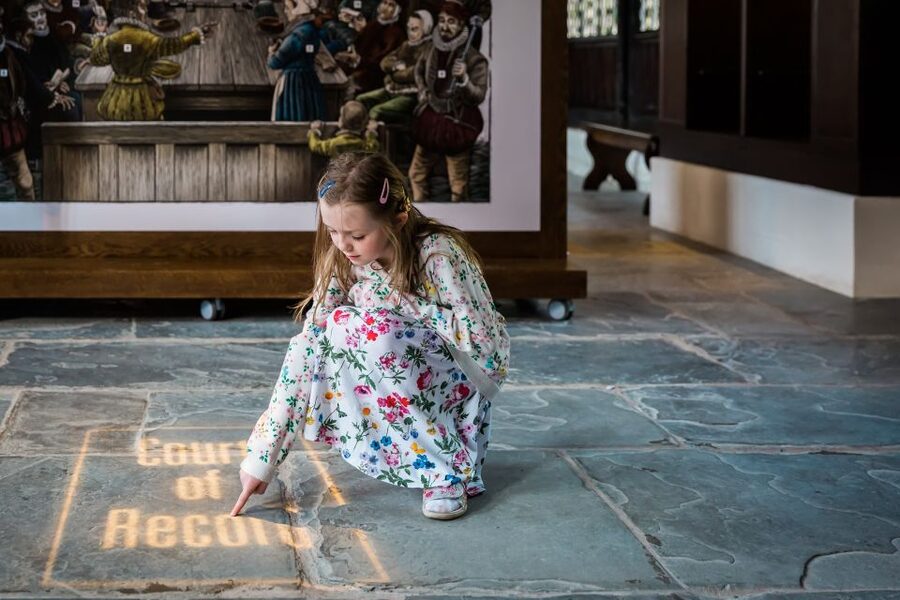
The stated duration is one hour. That makes this an easy addition to a day in Stratford-upon-Avon, especially if you are visiting several Shakespeare-related sites.
The hour is enough to cover the Guildhall, chapel, schoolroom, film, Tudor lesson, and hands-on elements in a focused way. It is not long enough for a slow museum visit or extended independent study. You will need to keep moving with the presentation.
I see the short length as a strength for most people. Shakespeare attractions can become repetitive if you visit too many in one day, but this stop has a clear shape and a manageable time commitment. It works well before lunch, between other central sights, or as a family activity that does not demand an entire afternoon.
The attraction is open daily, but starting times can vary. Check availability when booking so you can fit the hour around the rest of your Stratford plans.
Is $20 per person good value?
At $20 per person, this is not the cheapest quick stop in town, but the price is reasonable if you take part in the full experience.
You are paying for access to a genuine medieval building, a guided presentation, a Tudor lesson, the chapel and wall painting, a historical film, and hands-on activities. The schoolroom setting is the main value. You cannot recreate the feeling of sitting in that room with a book or a modern display elsewhere.
The price is less attractive if you only want to glance around the building. The attraction is small, and the visit lasts about an hour. You get better value by joining the lesson, trying the quill writing, and giving yourself time to look at the medieval details.
I would consider it particularly worthwhile for families, Shakespeare enthusiasts, and visitors who prefer active interpretation to a silent collection. If your main interest is large-scale architecture or a long museum visit, you may want to compare it with other Stratford sights before committing.
Who will enjoy this most?
Families have plenty to do, from Tudor clothing and games to quill writing and the schoolmaster’s lesson. The activities give children a reason to pay attention, while the building and Shakespeare connections give adults something more substantial.
Literature fans will appreciate the link between Shakespeare’s school education, classical reading, and performance. You also get a more grounded picture of his youth than you would from focusing only on his birthplace or later fame.
History enthusiasts should come for the Guildhall and chapel as much as for Shakespeare. The 1420 building and conserved wall painting are important parts of the experience, not filler between schoolroom activities.
The visit is also suitable for anyone wanting a short, central Stratford activity. It is wheelchair accessible, and the experience is delivered in English by guides and a Tudor schoolmaster.
Planning your Stratford visit
The meeting point is Shakespeare’s Schoolroom and Guildhall on Church Street, Stratford-upon-Avon, Warwickshire, CV37 6HB. Since the experience lasts one hour, you can place it alongside other sights without giving up half a day.
I would book a time that leaves you unhurried. The lesson is the part you most want to catch, and arriving with enough time to find the building will make the visit more relaxed. The venue is open daily, but you should check available starting times before making a detailed schedule.
Free cancellation is available up to 24 hours in advance, and you can reserve now while paying later. That is useful if your Stratford plans depend on weather, family energy, or other timed activities.
Should you book Shakespeare’s Schoolroom and Guildhall?
Book it if you want a concise, hands-on look at Shakespeare’s early life rather than another room of portraits and text panels. The Tudor lesson with Master Thomas Jenkins is the main reason to go, while the quill writing, costumes, chapel, and medieval wall painting add variety.
Skip it if you want a large museum, a long performance, or extensive independent viewing. The building is compact and the visit lasts only an hour.
For most first-time visitors to Stratford-upon-Avon, I think the combination works well. You see where the young Shakespeare studied, learn how Tudor education worked, and gain a better understanding of the medieval Guildhall that shaped the town’s civic and cultural life.
FAQ
Where is Shakespeare’s Schoolroom and Guildhall?
It is located on Church Street, Stratford-upon-Avon, Warwickshire, CV37 6HB.
How long does the visit last?
The experience lasts about one hour.
What is included in the admission?
Admission includes entry to Shakespeare’s Schoolroom and Guildhall, tour guides, and a lesson with Master Thomas Jenkins.
Is the Tudor lesson included?
Yes. A lesson with Master Thomas Jenkins is included in the visit.
Is the experience available in languages other than English?
The host or greeter language is English, and the listed experience language is English.
Is the attraction wheelchair accessible?
Yes, Shakespeare’s Schoolroom and Guildhall is wheelchair accessible.
Can I cancel my booking for a refund?
Yes. You can cancel up to 24 hours in advance for a full refund.
Can I reserve a place and pay later?
Yes. The reserve now and pay later option lets you book while paying nothing at the time of reservation.
Just added in Stratford Upon Avon
- Private Tour: The London of Shakespeare, the Beatles, James Bond and Sherlock Holmes by Traditional Black Cab★ 4.5 · 28 reviews
- Shakespeare Distillery Tour & Tasting (Gin & Rum)★ 4.8 · 69 reviews
- Stratford-upon-Avon: Tudor World Museum Entrance Ticket★ 4.4 · 34 reviews
- Stratford-upon-Avon: Lantern-Lit Ghost Tour at Tudor World★ 4.7 · 105 reviews
- From London: Shakespeare’s Stratford-upon-Avon Day Trip★ 4.1 · 172 reviews
- Stratford-upon-Avon: Anne Hathaway’s Cottage Entry ticket★ 4.7 · 41 reviews
- Stratford-Upon-Avon’s Town Walking Tour (10:30am & 2pm)★ 4.8 · 143 reviews
- The Sinister Side of Shakespeare’s Stratford Walking Tour★ 4.8 · 547 reviews
Literary Tours, compared.


The Sinister Side of Shakespeare’s Stratford Walking Tour
Read our review →

Shakespeare’s Stratford-upon-Avon Day Trip by Coach
Read our review →Browse the lists this tour appears in