
Reviewed · ROYAL TOURS
Private tour with an accredited expert guide Hampton Court Palace
Hampton Court Palace is far more than a line of grand rooms. It is a place where Henry VIII’s court cooked, argued, worshipped, slept, and showed off. Sarah Slater’s private tour helps you read the building as a working royal residence, not just a collection of old walls.
I especially like the mix of Tudor and Baroque England, from the smoky kitchens and Abraham Tapestries to William and Mary’s attempt to rival Versailles. I also like the private format, which lets you ask about architecture, royal succession, garden design, or even the palace graffiti. The main drawback is cost: the guide fee is per group, but palace admission is extra for every person.
Key points to know before you book
- Sarah Slater brings long experience: She is an Institute of Tourist Guiding accredited White Badge Guide and worked as a Guide Lecturer at Hampton Court from 2008.
- The tour crosses two royal worlds: You see Henry VIII’s Tudor palace and the later Baroque additions of Queen Mary II and King William III.
- The group stays private: Up to 15 people can join, and you can shape the conversation around your interests.
- The kitchens make the palace feel real: You get a sense of the servants, smells, noise, and huge effort behind royal meals.
- The gardens are part of the visit: The route includes the famous hedge Maze, Great Vine, Royal Tennis Court, and King’s Privy Garden.
- Admission is not included: The listed information gives palace admission figures of £30.90 and £32 per person, so check the current amount before booking.
Why Hampton Court works so well with a private guide
Hampton Court can be confusing at first. It began as Cardinal Wolsey’s grand residence, became one of Henry VIII’s favorite palaces, and later changed again under William III and Mary II. The result is a sprawling complex with different styles, rulers, and purposes layered together.
A self-guided visit gives you plenty to see, but it may not explain why one corridor matters more than another or how a room fit into court life. Sarah’s role is to connect the pieces. She can explain royal succession, architecture, household routines, art, gardens, and the personalities linked to the palace.
That matters most if this is your first visit. You are not simply looking at a bedchamber or a decorated ceiling. You are learning who could enter, who had to wait outside, where servants worked, and how royal status was displayed through space.
The private format is useful for families and mixed-interest groups. One person can ask about Henry VIII’s marriages, another about the building, and another about the gardens. Sarah has also been praised for adjusting her approach to children and teenagers, including groups with several young people. That flexibility is difficult to get on a large group tour.
The tour is offered in the morning or afternoon, lasts about two to two and a half hours, and is limited to your party. The stated itinerary describes about two hours of touring, so treat the longer figure as a reasonable allowance rather than a guaranteed extra half hour.
More Castle Tours in London
- Buckingham Palace: The State Rooms Entrance Ticket
★ 4.6 · 7,395 reviews - London: Buckingham Palace & Changing of the Guard Experience
★ 4.3 · 2,971 reviews - London: Buckingham Palace Entry & Changing of the Guard Tour
★ 4.2 · 2,221 reviews
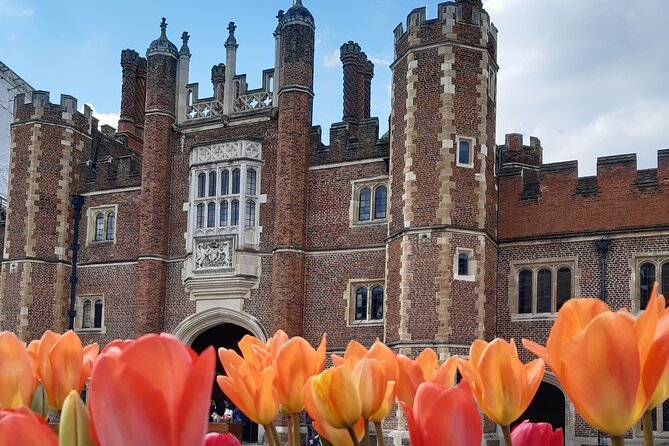
Entering through the Tudor Gatehouse
The tour begins at the meeting point at 64 Hampton Ct Way in East Molesey, near Hampton Court Palace. From there, you enter through the Tudor Gatehouse, an effective opening because it immediately shifts your attention from modern London to the world of the 16th century.
The gatehouse is not just a doorway. It introduces the palace as a controlled royal environment. Once inside, you can begin to understand how courtiers, servants, visitors, and officials moved through the complex.
Sarah’s strongest subject is the way court life operated. She can put names and ranks into context, explaining why a particular room mattered and how the royal household was organized. A private guide also gives you room to stop and ask for clarification instead of trying to keep up with a larger group.
If you have a special interest, say so early. The tour can give more attention to architecture, political history, the monarchy, art, or the daily work of the palace. That is one of the clearest advantages over simply following signs from room to room.
The Tudor Kitchens and the machinery of royal meals
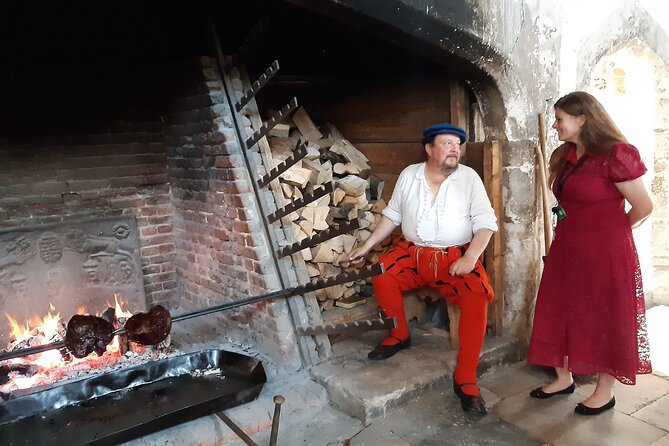
The Tudor Kitchens are among the most appealing parts of the route because they show the palace from the servants’ side. Grand banquets did not appear by magic. They required many workers, large quantities of food, careful planning, and constant movement.
Here, you can picture the palace as a working operation. The sounds and smells would have been very different from the polished State Apartments upstairs. This contrast is important. It reminds you that Hampton Court was both a display of royal power and a demanding workplace.
I like this portion because it gives children and adults an easy way into the subject. Food, fire, work, and household organization are tangible. You do not need a specialist interest in Tudor politics to appreciate how much labor supported the court.
The kitchens also help explain the palace’s scale. As you move through the grand rooms later, you have a better sense of the service network behind them. A guide can point out how the public image of royal abundance depended on people who remained largely out of sight.
Tudor State Apartments, tapestries, and Henry VIII’s family
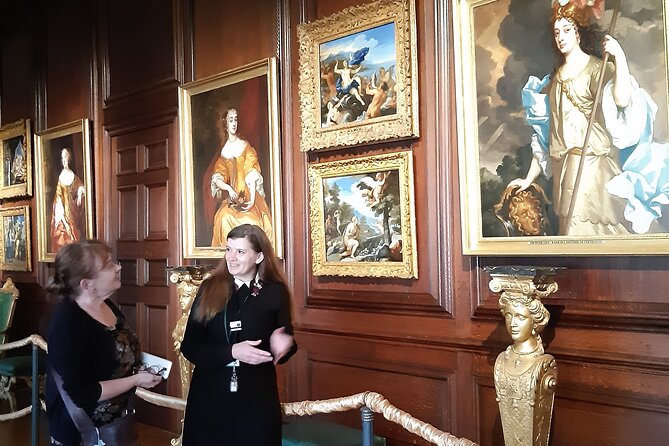
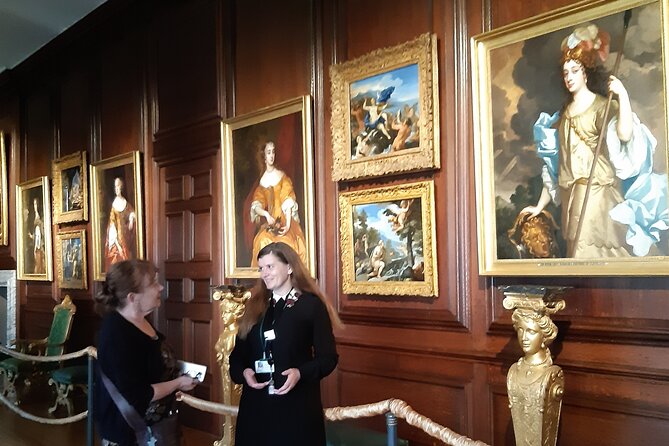
The upper floors bring you into the Tudor State Apartments, where ceremony and image take over. These rooms contain major artwork and tapestries, including the Abraham Tapestries and the painting of the Family of Henry VIII.
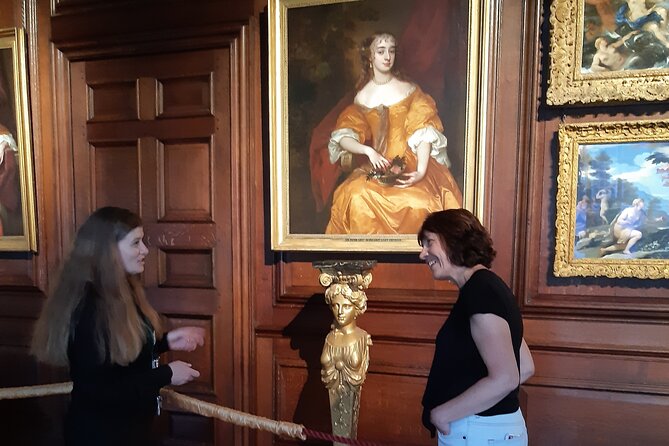
The art is not simply decoration. Tapestries were costly, portable statements of wealth and learning. They helped make a room warmer, more impressive, and more politically useful. A guide can help you notice details you might pass without a second glance, including symbols, figures, and visual references to royal authority.
The Family of Henry VIII is especially useful for understanding how the king wanted his dynasty to be seen. Royal portraits often present an ideal version of family and succession, even when real court politics were tense and uncertain.
This is also where Sarah’s ability to match the group’s interests becomes valuable. If you care most about monarchy and succession, you can spend time with the people and events behind the images. If art is less important to you, the visit can move on without turning into a long lecture about every brushstroke.
More Royal Tours in London
- Tower of London and Crown Jewels Exhibition Ticket
★ 4.5 · 6,677 reviews - London: Changing of The Guard Tour
★ 4.8 · 2,510 reviews - London: Westminster and Changing of the Guard Tour
★ 4.5 · 2,171 reviews - London: Westminster Abbey, Big Ben & Buckingham Guided Tour
★ 4.8 · 2,170 reviews
The Great Hall and Catherine Howard’s Haunted Gallery
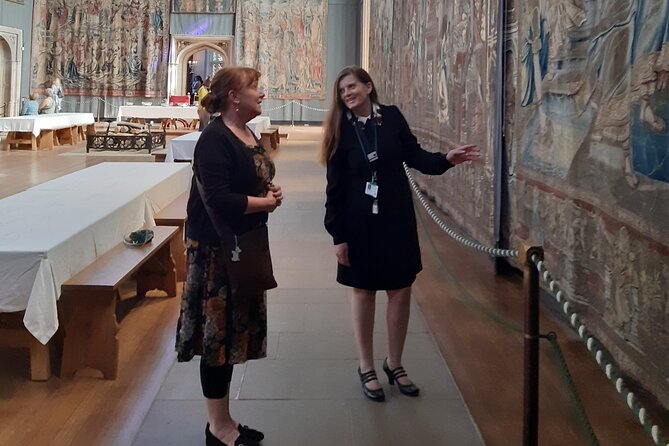
The Great Hall is one of the palace’s most memorable Tudor spaces. It was designed for display, ceremony, and communal life, and its size gives you a clear sense of how the court presented itself.
From there, the route continues along the Haunted Gallery. This is where Sarah tells the story of Catherine Howard, Henry VIII’s fifth wife. Her fate gives the palace one of its most famous ghost stories, but the human story matters more than the spooky label.
Catherine was a young queen caught in a dangerous court. Her story opens questions about marriage, reputation, power, and the risks faced by people close to Henry VIII. The Haunted Gallery is a good setting for it because the corridor links the physical palace with one of its most enduring legends.
This part can work well for families, but the subject is serious. You can expect Tudor politics to be presented through personalities and consequences, not as a light costume story. Sarah’s calm, engaging manner is especially useful here, keeping the tale clear without making it melodramatic.
The Baroque palace of William III and Mary II
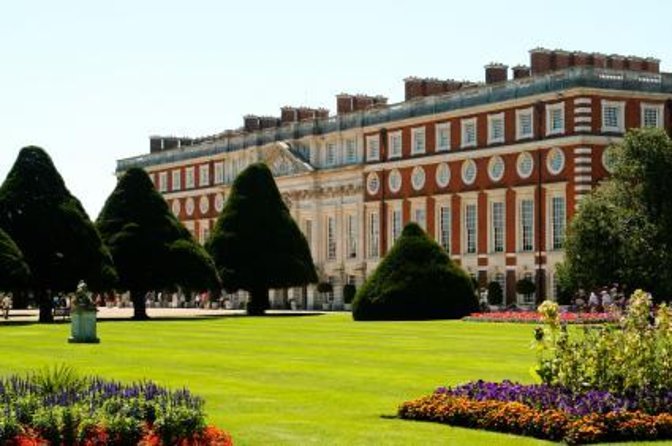
Hampton Court is often associated almost entirely with Henry VIII, but the later Baroque section changes the mood. Queen Mary II and King William III rebuilt part of the palace from 1689 in an effort to rival Versailles near Paris.
The contrast is one of the best reasons to take this tour. Tudor Hampton Court feels tied to dynastic ceremony, court ritual, and medieval forms of power. The Baroque rooms reflect a later royal ambition, with a more ordered and fashionable style linked to European competition.
A guide helps you see that this was not just renovation for comfort. Architecture carried political meaning. Building on such a scale announced status and placed the English monarchy within a wider European contest.
The transition also prevents the visit from becoming a narrow Henry VIII lesson. You see how one royal residence was repeatedly changed to suit new rulers, tastes, and political needs. That broader view gives Hampton Court its particular interest.
Gardens, the Maze, Great Vine, and Royal Tennis Court
The gardens complete the visit. The route includes the world-famous hedge Maze, the Great Vine, the Royal Tennis Court, and the King’s Privy Garden.
Each feature offers a different way to understand royal life. The Maze is playful and memorable, but it also reflects the period’s taste for designed gardens and controlled nature. The Great Vine points to horticultural skill and royal display. The Royal Tennis Court connects the palace to court recreation, while the Privy Garden shows how outdoor space could be planned for privacy and ceremony.
The gardens are also a practical reason to leave time after the guided portion. One family used the two-hour tour as an introduction and then spent several more hours exploring the palace and grounds independently. That is a smart way to use the experience: let Sarah give you the structure, then return to the rooms or gardens that interest you most.
Do not assume the guide’s two hours covers every corner at leisure. Hampton Court is large, and a focused tour necessarily selects highlights. If you want a slow visit to every gallery, read every panel, and spend extended time in the gardens, plan additional time after the tour.
What Sarah Slater adds to the visit
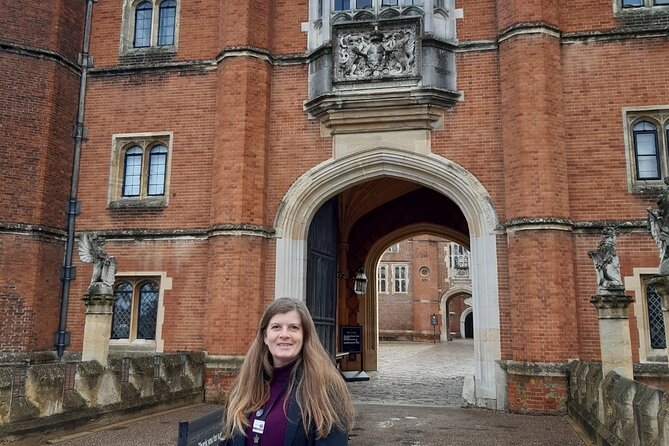
Sarah is an accredited White Badge Guide and has worked as a Guide Lecturer at Hampton Court since 2008. That background matters because the palace is not a place where a few memorized dates are enough.
Her strength is making information usable. She can explain royal lineage and succession, then shift to architecture, room assignments, court manners, art, or garden planting. She has also been recognized by authors and interviewed for her expertise at Hampton Court.
The personal format seems particularly helpful when your group has uneven interests. You can ask about the origin of words and expressions, the meaning of graffiti on the stonework, or how the royal household functioned. You can also ask for photographs, a small kindness that has been appreciated by previous groups.
Sarah’s approach is not limited to adults. Families with children as young as 10 and groups with teenagers have found the material accessible and engaging. That does not mean every child will enjoy two hours of palace history, but the private setting gives the guide a better chance to include them.
Price, group size, and overall value
The listed guide price is $345.84 per group of up to 15 people. Palace admission is extra, with the supplied details giving figures of £30.90 and £32 per person. Because those two admission amounts differ, check the current price when you book.
For one or two people, the total cost can feel high once admission is added. For a larger family or group, the guide fee spreads across more people and becomes easier to justify. Eight or ten people receiving a private tour is a different value calculation from a couple paying the entire group rate.
The real question is how much structure you want. If you are happy to wander, read signs, and accept that some context will be missed, independent admission may suit you. If Hampton Court is a major part of your London plans, Sarah’s experience can make the visit more focused and less confusing.
The tour is also a good value for repeat visitors who want a different angle. You can request more architecture, court politics, gardens, or daily life rather than simply repeating a general introduction.
Timing, access, and useful planning notes
You can choose a morning or afternoon start. Pick the time that leaves you enough room to continue exploring afterward, since the palace and gardens can occupy much of a day.
The activity starts and ends at the stated meeting point. It is near public transportation, and confirmation is provided at booking. Service animals are allowed, and the information says most people can participate.
The Chapel Royal is a working chapel and can close at short notice for services. Treat it as a possible part of the palace visit, not a guaranteed stop.
The activity is offered in English. Since it is private, your group can ask questions freely, but it is still worth telling Sarah in advance if you have a strong preference for Tudor politics, Baroque architecture, art, gardens, or family-friendly storytelling.
Free cancellation is available if you cancel at least 24 hours before the local start time. Changes or cancellations inside that window are not accepted for a refund.
Who should book this Hampton Court tour?
I would choose this tour if Hampton Court is high on your London list and you want the palace to make sense rather than simply look impressive. It is especially suited to families, history fans, first-time visitors, and groups with different interests.
It is also a strong choice for anyone fascinated by Henry VIII and his six wives, though the tour offers more than Tudor drama. You will also see the Stuart and Georgian-era additions, the gardens, and the architectural argument with Versailles.
I would think twice if you want a very inexpensive visit, prefer complete independence, or plan to spend the whole day silently studying art. The private guide fee is easiest to defend when you value questions, context, and a route shaped around your group.
Should you book it?
Book it if you want Hampton Court to feel like a living royal workplace, not a string of rooms with labels. Sarah Slater’s long experience, private format, and ability to adjust the tour make this a particularly appealing choice for families and curious groups.
The best plan is to reserve the two-hour introduction, then keep several extra hours for the palace and gardens. With admission charged separately, compare the total cost with your group size. For a larger party, the private format offers strong value. For a couple on a tight budget, it is a special splurge, but one that can make this complicated palace far easier to understand.
FAQ
How long is the private Hampton Court Palace tour?
The tour lasts approximately two to two and a half hours. The stated itinerary describes two hours of touring.
How many people can join the private tour?
The tour accommodates up to 15 people per group, and only your group participates.
Who is the guide?
The guide is Sarah Slater, an accredited Institute of Tourist Guiding White Badge Guide. She has worked as a Guide Lecturer at Hampton Court Palace since 2008.
Is Hampton Court Palace admission included?
No. Palace admission is not included in the tour price. The supplied information lists admission figures of £30.90 and £32 per person, so check the current amount before booking.
What does the tour include?
The route includes the Tudor Gatehouse, Tudor Kitchens, Tudor State Apartments, Abraham Tapestries, the Family of Henry VIII, Great Hall, Haunted Gallery, Baroque areas, and gardens with the Maze, Great Vine, Royal Tennis Court, and King’s Privy Garden.
Can the Chapel Royal be visited?
The Chapel Royal is a working chapel and may close at short notice for services, so access is not guaranteed.
Just added in London
- Royal London Guided Sightseeing Tour and Thames River Cruise★ 4.0 · 31 reviews
- Roman Ruins to Blitz Bombings: A Walking Tour of London’s Fiery History★ 5.0 · 190 reviews
- Roman London Private Walking Tour★ 5.0 · 44 reviews
- Westminster Abbey, Big Ben, Buckingham Guided Tour of London★ 5.0 · 451 reviews
- River Thames Evening Cruise with Sparkling wine and Canapés★ 4.0 · 569 reviews
- Rock and Roll Walking Tour of Soho London★ 4.5 · 64 reviews
- Rich people behaving badly★ 5.0 · 47 reviews
- Speedboat Sightseeing: Embankment OR Westminster Pier -45 Minutes★ 5.0 · 288 reviews
Royal Tours, compared.

Stonehenge, Windsor Castle, and Bath from London
Read our review →
Stonehenge, Windsor Castle and Bath with Pub Lunch in Lacock
Read our review →
Buckingham Palace: The State Rooms Entrance Ticket
Read our review →
Tower of London and Crown Jewels Exhibition Ticket
Read our review →
Stonehenge, Windsor Castle and Bath Full Day Guided Tour
Read our review →
Windsor Castle, Stonehenge, and Oxford Day Trip from London
Read our review →
Windsor Castle, Stonehenge & Bath Full-Day Tour
Read our review →Browse the lists this tour appears in