
Reviewed · WALKING TOURS
Burnings, Butchery & Black Death: A Walking Tour of London’s Bloody Past
London’s darkest stories are often tucked behind ordinary streets. This two-hour walk links a plague pit, a medieval meat market, an old hospital, a Victorian sewer, and the alley where the Great Fire finally stopped. You get a thousand years of grim London without spending the day in a museum.
I like the small group limit of 15, which makes it easier to hear the guide and ask questions. I also like the range of subjects. This is not another Jack the Ripper walk. You’ll hear about plague, burnings, public executions, bomb damage, ghost scares, medieval orders, and the city’s long struggle with disease.
The main drawback is the pace. Ten stops in about two hours means some places receive only a short explanation. You’ll also need to walk outdoors in possibly wet weather, and the tour may be canceled if conditions are poor.
Key points to know before booking
- A thousand years in two hours: The route connects medieval, Tudor, Georgian, Victorian, and wartime London.
- Small groups matter: A maximum of 15 people helps you hear stories in busy streets and narrow lanes.
- Tom is a strong guide choice: His style mixes solid historical detail, humor, local anecdotes, and answers to questions.
- Look beyond the famous sights: Charterhouse, Cloth Fair, St John’s Gate, and the Golden Boy are easy to miss on your own.
- The walk ends near Farringdon: You finish on Ely Place, around the corner from Farringdon Station.
- Good value for history fans: At $27.73, the tour costs less than many London attractions while covering a large amount of ground and story.
Why this part of London makes such a good setting
This walk takes place around the City of London and nearby Clerkenwell, an area where the modern city sits directly on top of older ones. Glass offices, traffic, pubs, churches, and markets share the same few streets as plague pits, monastic buildings, execution sites, and former waterways.
That close spacing gives the tour its appeal. You are not driven from one attraction to another. Instead, you walk from place to place and see how the city grew around old institutions and old problems. A meat market became a public-health concern. A river became an open sewer. A monastery became tied to plague burials. A church survived centuries of fire, war, and redevelopment.
The route also avoids the usual narrow focus on Jack the Ripper. The darker side of London was much broader than one Victorian criminal. You hear about disease, punishment, war, superstition, crowded markets, medical care, and the way ordinary people dealt with disaster.
Guide Tom is especially suited to this material. His delivery combines facts with quick humor, and he is able to connect older events to modern London. He also adds passing details, including filming locations and stories tied to the streets you are walking through.
More Walking Tours in London
- London: The Original Jack the Ripper Walking Tour
★ 4.7 · 7,833 reviews - Tour for Muggles The Ultimate Harry Potter Walking Tour in London
★ 5.0 · 4,684 reviews - London Jack The Ripper Guided Walking Tour
★ 5.0 · 3,131 reviews
Charterhouse and the plague pit
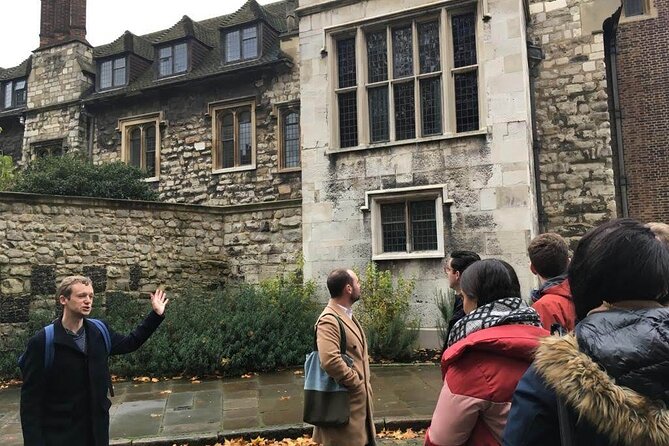
The tour begins at The Charterhouse, a fourteenth-century monastery associated with a plague pit. This is an effective opening because it places you right beside one of London’s most unsettling realities: the city’s dead were not always buried in neat churchyards.
The site introduces the scale of disease in medieval London and the role religious houses played in the life of the city. You’ll hear about a place that began as a monastic institution and became linked with one of the worst public-health disasters in European history.
You spend about ten minutes here, so do not expect a long interior visit. Admission is free, and the value comes from the guide’s explanation of what the site represents. Look closely at how little the modern surroundings announce the events connected with the ground beneath them.
Smithfield Market and the practical side of death
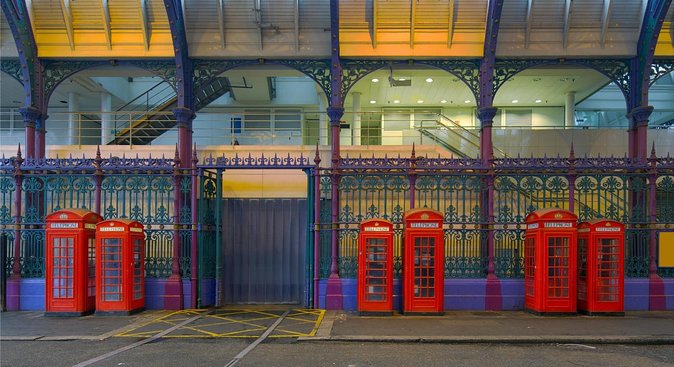
From Charterhouse, the walk continues to Smithfield Market, a meat market with roughly a thousand years of history. This is one of the route’s best stops because the subject is not only gruesome. It also explains how London fed itself and why markets could become dangerous places.
Smithfield’s story connects trade, animals, crowds, waste, disease, and public order. A market that served the city for centuries also became associated with executions and other violent episodes. The guide brings together those different threads rather than treating the place as a single-purpose attraction.
You’ll spend around ten minutes here. The market is still a working part of London, so this stop feels less like a preserved historical site and more like an old urban function continuing in a changed form. That contrast is useful. London’s past is not locked away behind glass.
St John’s Gate and the medieval Knights Hospitallers
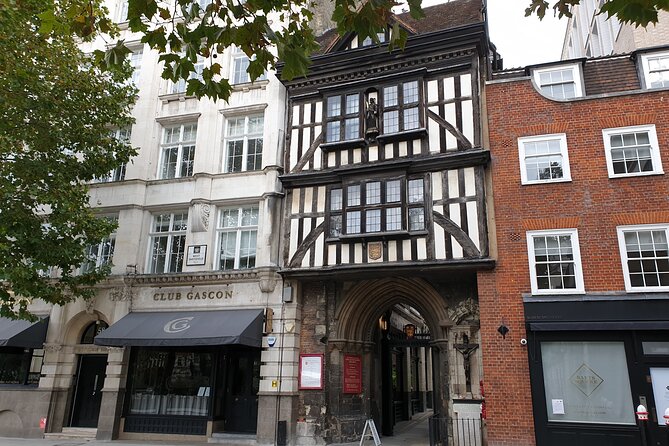
St John’s Gate introduces the medieval Knights Hospitallers, an order connected with care, religion, and military power. The building gives the tour a welcome shift in mood after the market and plague stories.
This stop helps you see how religious orders shaped London beyond worship. They held property, cared for the sick, and operated within the power structures of medieval Europe. The surviving gate is an architectural reminder of that world, even though the streets around it now feel thoroughly modern.
You get about ten minutes here. The stop is best for people who enjoy seeing how institutions worked, not just hearing dates and battles. It also prepares you for the later visit to St Bartholomew’s Hospital, where medical care becomes another major part of the route.
Same trip, a completely different kind of day:
- London: The London Eye Entry Ticket
★ 4.6 · 35,875 reviews - From London: Harry Potter Warner Bros Studio Tour
★ 4.7 · 26,588 reviews - London: Westminster to Greenwich River Thames Cruise
★ 4.5 · 22,836 reviews - London: Madame Tussauds London
★ 4.6 · 20,915 reviews
Cloth Fair, William Wallace, and stories hiding in narrow lanes
Cloth Fair is a quiet alley with a noisy past. It is the sort of place you could easily walk through without noticing, especially if you were following a map between larger attractions. The guide gives the lane its context, showing how small spaces can hold stories about crowds, trade, punishment, and survival.
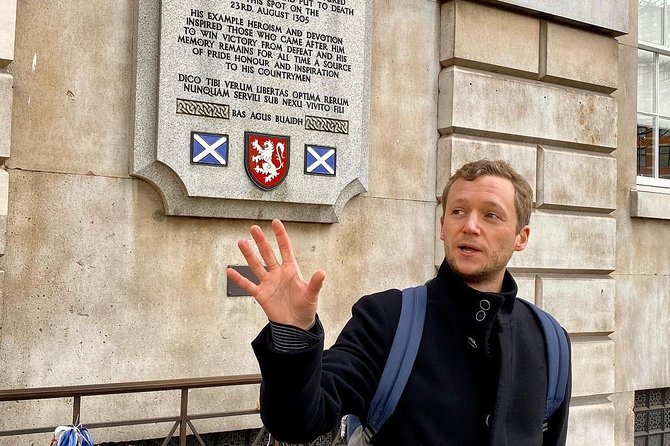
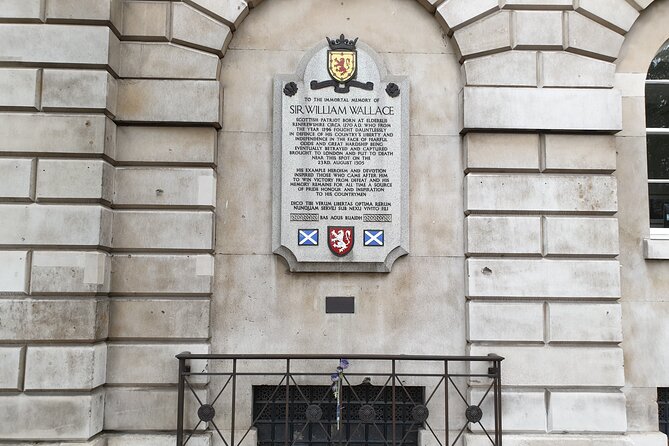
The William Wallace Memorial comes next. Wallace, known widely through the name Braveheart, is remembered here in London for a much darker reason. The memorial gives the guide a chance to discuss the Scottish resistance leader and the city’s role in public punishment.
These stops are close enough together to keep the route moving, but they also show why a guided walk helps in this part of London. You might see a sign, a doorway, or a plaque on your own. The difficult part is knowing what happened there and why it matters.
St Bartholomew the Great, London’s oldest surviving parish church
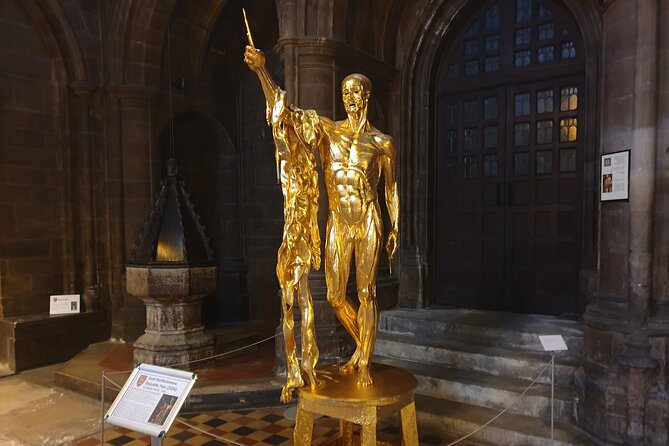
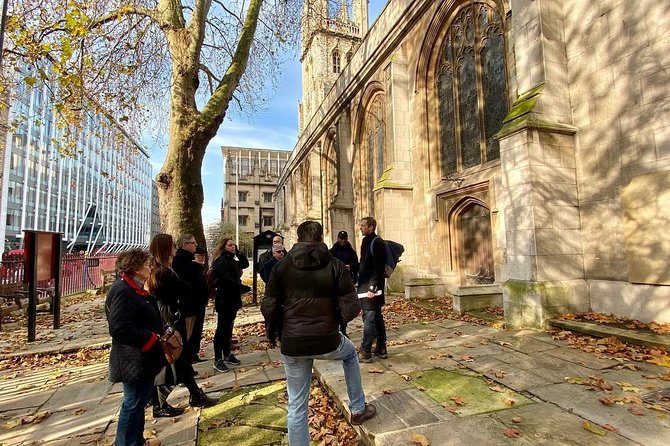
Church of St Bartholomew the Great is one of the route’s major highlights. It is described as London’s oldest surviving parish church, and the interior gives you a stronger sense of the city’s medieval fabric than the outdoor stops can provide.
The church’s age is important, but the atmosphere matters just as much. You are stepping into a building that has witnessed changes in worship, government, medicine, trade, fire, and urban growth. The church has also appeared in film locations, a detail Tom may connect to the surrounding streets.
Unlike most stops, admission to the church is included. You should expect only about ten minutes here, so the visit will not cover every architectural detail. Still, that short pause inside an old church breaks up the outdoor route and adds weight to the stories about plague and medieval London.
The Golden Boy and the Great Fire
The Golden Boy of Pye Corner marks the point where the Great Fire of 1666 finally died out. The monument is small, but its meaning is large. It points to a disaster that reshaped London and changed how people thought about building, fire, and the city’s crowded streets.
The stop also brings in eighteenth-century ghost hysteria. That makes the story more than a standard account of flames and rebuilding. London’s disasters produced fear, rumor, strange explanations, and a lasting appetite for supernatural tales.
This is a good example of the tour’s broad approach. You are not only given a date and a famous event. You see how people responded emotionally and socially to danger. The Golden Boy is easy to overlook, which is exactly why the guide’s explanation adds value.
Holborn Viaduct and the lost River Fleet
At Holborn Viaduct, the focus shifts to the River Fleet, described as Victorian London’s largest open-air sewer. Today, the river is largely out of sight, but its former route helps explain why parts of London developed as they did.
This stop shows the less romantic side of industrial growth. London needed water, drainage, transport, and waste removal, but those systems often lagged behind the city’s expanding population. The Fleet became a symbol of pollution and poor urban sanitation before being covered over.
You will not see a flowing river here. The point is to imagine the waterway beneath the modern street and understand how much of London’s infrastructure has been buried or reshaped. For me, this is one of the most useful stops because it connects old sanitation problems with the city you see today.
Ye Olde Mitre and a fitting place to pause
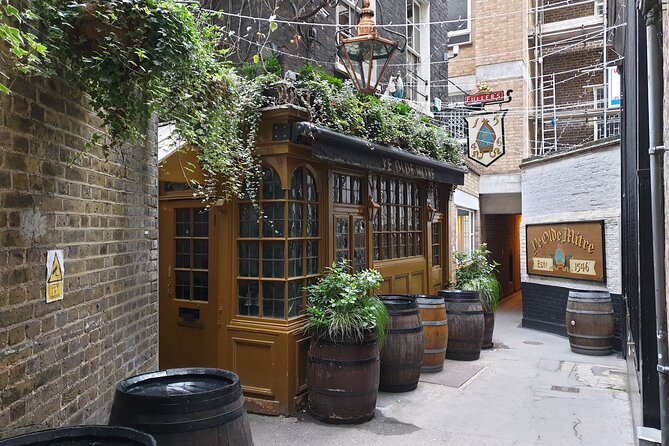
The walk reaches Ye Olde Mitre, a pub tucked down an alleyway on Ely Place. It is described as a hidden gem, but the real appeal is its setting and age. The pub feels like a fitting endpoint for a tour about ordinary London life surviving alongside major events.
The tour information does not say that food or drinks are included, so plan to pay separately if you decide to stop. The pub is a useful place for lunch or a drink after the walk, and cheese toasties and pork pies are specifically praised as options.
Do not confuse this with a pub tour. The walk is about history, not drinking. Still, ending near a traditional pub gives you a chance to continue the conversation, rest your feet, and consider how much of London’s past survives in everyday places.
St Bartholomew’s Hospital and the medical story of London
The final listed stop is the St Bartholomew’s Hospital Museum, part of the oldest surviving hospital in the country. This brings the route back to care, illness, and the long effort to understand the human body.
The hospital adds balance to the tour’s darker material. London’s past was not only about death and punishment. It was also about people trying to treat disease, care for the poor, and improve medicine with limited tools and imperfect knowledge.
The museum is especially useful after Charterhouse, Smithfield, and the River Fleet. Those earlier stops show the causes and conditions that made city life dangerous. The hospital shows one of the institutions that tried to respond.
The end point is Ely Place, around the corner from Farringdon Station. That makes onward travel simple, with public transport nearby.
What the $27.73 price gets you
At $27.73 per person, this is a reasonably priced way to spend two hours in central London. You are paying for a guide who links ten sites into one story, not for entry to a series of major paid attractions. Most stops are free, and the church admission is included.
The value depends on how you like to sightsee. If you prefer long visits inside museums, this walk may feel too quick. If you enjoy learning why ordinary streets matter, the price is easier to justify. You get local context that a self-guided map usually cannot provide, especially at Cloth Fair, the Golden Boy, and the former River Fleet.
The tour is also a good use of time early in a London visit. It gives you a working sense of the City and nearby streets, then points you toward places you may want to revisit at a slower pace.
Timing, group size, and walking conditions
The advertised duration is approximately two hours. Ten stops at roughly ten minutes each leaves time for walking between them, though the actual pace may vary with the group and street conditions.
The group limit is 15 people. That is small enough for the guide to keep the group together and answer questions, but it is not a private tour. Wear comfortable shoes and expect to spend the whole experience outdoors apart from the church or museum portions.
The tour requires good weather. If poor weather causes cancellation, you are offered another date or a full refund. You can cancel for a full refund up to 24 hours before the start time, but changes or cancellations inside that window are not accepted.
The meeting point is Underground Ltd on Aldersgate Street in Barbican, London EC1A 4JA. The walk ends on Ely Place, around the corner from Farringdon Station. A mobile ticket is provided, and the tour is offered in English.
Service animals are allowed, and most people can take part. The supplied information does not give a detailed accessibility assessment, so contact the provider if you need specific guidance about surfaces, steps, or interior access.
Who should book this London history walk
I would choose this tour if you have already seen the main landmarks and want a less polished, more local look at London. It is especially suited to people who enjoy social history, old buildings, medical stories, crime, disasters, and the odd ghost tale.
It also works well for first-time visitors who want a strong orientation to the City of London. The route shows how much is packed into a small area and gives you ideas for further exploring after the walk.
You may want to skip it if you dislike grim subjects, outdoor walking, or fast-moving tours. The title is accurate: plague, butchery, burnings, and the Black Death are central themes. The humor keeps the material approachable, but it does not remove the darker content.
Should you book Burnings, Butchery & Black Death?
Yes, if you want London history with plenty of personality and little reliance on the city’s most familiar crime stories. The best parts are the small group, the overlooked sites, the broad time span, and Tom’s lively way of connecting details across the route.
At $27.73, it is a strong choice for a two-hour introduction to London’s darker past. Just allow for a brisk pace, dress for the weather, and do not expect long interior visits at every stop. Book it if you want the streets themselves to become your museum.
FAQ
How long does the tour last?
The tour lasts approximately two hours.
How much does the tour cost?
The price is $27.73 per person.
How large is the tour group?
The maximum group size is 15 people.
What language is the tour offered in?
The tour is offered in English.
Where does the tour begin?
The tour begins at Underground Ltd on Aldersgate Street in Barbican, London EC1A 4JA, UK.
Where does the tour end?
The tour ends on Ely Place, around the corner from Farringdon Station.
Can I cancel for a full refund?
Yes. You can cancel at least 24 hours before the experience start time for a full refund. If poor weather causes the tour to be canceled, you are offered another date or a full refund.
Just added in London
- Royal London Guided Sightseeing Tour and Thames River Cruise★ 4.0 · 31 reviews
- Roman Ruins to Blitz Bombings: A Walking Tour of London’s Fiery History★ 5.0 · 190 reviews
- Roman London Private Walking Tour★ 5.0 · 44 reviews
- Westminster Abbey, Big Ben, Buckingham Guided Tour of London★ 5.0 · 451 reviews
- River Thames Evening Cruise with Sparkling wine and Canapés★ 4.0 · 569 reviews
- Rock and Roll Walking Tour of Soho London★ 4.5 · 64 reviews
- London Private Chauffeur Half-Day or Full-Day Vehicle Rental★ 5.0 · 37 reviews
- Rich people behaving badly★ 5.0 · 47 reviews
Walking Tours, compared.
Underground Vaults Walking Tour in Edinburgh Old Town
Read our review →
Oxford University Walking Tour With University Alumni Guide
Read our review →
Edinburgh Castle: Guided Walking Tour with Entry Ticket
Read our review →
Edinburgh Castle Guided Walking Tour in English
Read our review →
Tour for Muggles The Ultimate Harry Potter Walking Tour in London
Read our review →
University and City Walking Tour with Alumni Guide
Read our review →
Edinburgh Darkside Walking Tour: Mysteries, Murder and Legends
Read our review →
Browse the lists this tour appears in